Real-world trucking route is helping the Edmonton Region Hydrogen Hub collect data for future infrastructure buildout in Western Canada
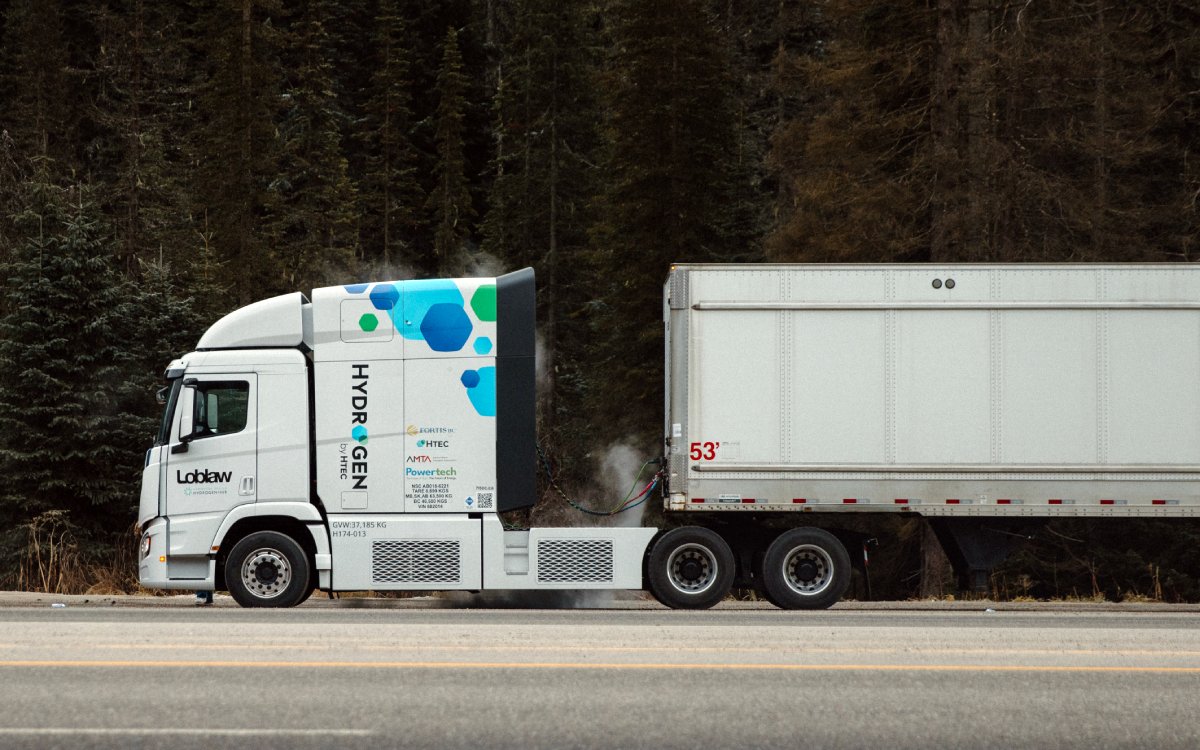
The Hyundai Xcient fuel-cell truck, operated by Loblaw, covered 1,046 kilometres over two days from Vancouver to Balzac, Alta. – Edmonton Region Hydrogen Hub
Real-world trucking route is helping the Edmonton Region Hydrogen Hub collect data for future infrastructure buildout in Western Canada
A hydrogen-powered Class 8 truck has hauled a load of commercial freight from Vancouver to Calgary, crossing some of the toughest mountain terrain in the country, in a test organizers say will help decide where fuelling stations are built in Western Canada.
The Hyundai Xcient fuel-cell truck, operated by Loblaw Companies Ltd., covered 1,046 kilometres over two days and delivered its load to the grocer’s site in Balzac, Alta., just north of Calgary, on Wednesday.
Along the way it climbed the Coquihalla Highway, Rogers Pass and Kicking Horse Canyon, gaining a cumulative 8,783 metres in elevation — nearly the height of Mount Everest.
Future investment
Mohamed M. Khaja is the program director of mobility at the Edmonton Region Hydrogen Hub (ERHH), which organized this pilot project. He said the goal was to gain more practical knowledge of the route to inform future investment decisions on fuel infrastructure.
“It’s one thing to have the modelling [of hydrogen trucking],” said Khaja in an interview with Electric Autonomy. “The real-world data is what we need.”
Khaja said the route was chosen because it is a regular freight corridor that combines cold weather, high elevations and grades of up to 8.4 per cent on Rogers Pass.
Mobile fillups
The hydrogen hub, formed by regional economic development groups including Edmonton Global, Alberta’s Industrial Heartland Association, Edmonton International Airport and Alberta Innovates, has been working on hydrogen trucking for three years. The trip is part of its Western Canada Hydrogen Corridors Initiative, which aims to link Edmonton, Calgary, Vancouver and other markets with fuelling infrastructure.
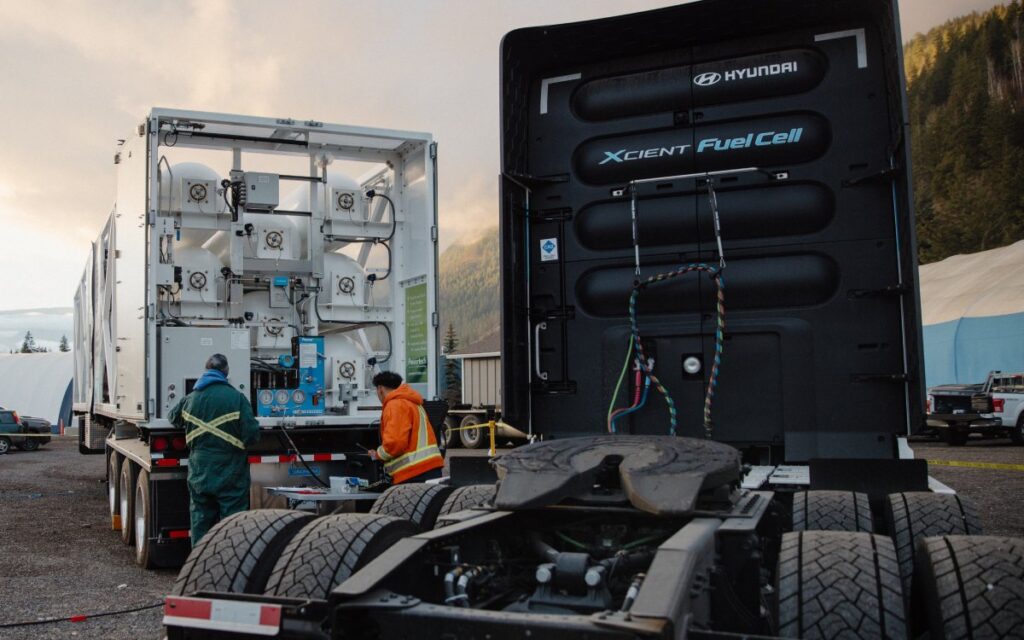
Because there are no hydrogen filling stations along the route, Powertech Labs, a subsidiary of BC Hydro, brought a mobile hydrogen trailer holding 1,050 kilograms of fuel with 517 bar of pressure to Sicamous, B.C., for a refill on the first day before moving it to Golden, B.C., for the second.
Rob Wiebe, Loblaw’s chief supply chain officer, said in a statement that working with multiple stakeholders is key to understanding what the technology can do.
“Initiatives like this give us valuable real-world insights as we continue to explore practical ways to improve the efficiency of our operations and reduce emissions. This collaboration across industries is an important part of understanding what’s possible.”
Made for long hauls
Longer hauling is where hydrogen fuel-cell heavy trucks have excelled over electric trucks, at least for now. Hyundai claims its Xcient has up to 720 km of range pulling a full load, whereas earlier electric trucks got around half that. Current electric Class 8 trucks are getting more range, the highest being over 800 km from the Tesla Semi.
Hydrogen refills take less than 20 minutes for a full tank. Electric charging has traditionally taken one to two hours to top up a large battery, depending on the charging speed, but newer megawatt charging systems promise charging times of under an hour for significant range.
While Khaja did not give cost figures for the truck, fuel-cell electric vehicle (FCEV) Class 8 trucks generally run up to 2.5 times the cost of comparative diesel trucks. He expects prices to drop as demand grows and manufacturers move to series production.
Khaja also points out that FCEV heavy trucks qualify for zero-emission vehicle (ZEV) incentive programs such as Go Electric BC, which offers $130,000 per ZEV for commercial organizations and $156,000 for Indigenous and non-profit organizations and municipal governments.
High fuel prices
High fuel pricing is also an issue. In Vancouver, hydrogen costs around $16.50 per kilogram. One kilogram is roughly 3.3 times the energy equivalent of a litre of diesel fuel, which is over $1.80/L in Vancouver as of writing.
There are just six permanent HTEC filling stations around southern B.C. that supply hydrogen made with hydroelectricity.
“As we scale down the road in the future, that’s when the cost comes down to a more affordable level compared to what we have right now,” said Khaja.
Multiple project partners
The ERHH had multiple partners on the project.
The truck, which is owned by HTEC and leased to Loblaw, filled up at HTEC’s station in Vancouver.
The Alberta Motor Transport Association, Backwoods Energy Services, BDS Inc., Twin Anchors Marine Industrial and HR Pacific Construction Management were all involved.
Funding came from FortisBC’s Clean Growth Innovation Fund, Alberta Innovates, the Alberta Ecotrust Foundation, Emissions Reduction Alberta and the hub itself.
“It was a village,” Khaja said of the effort.
The run builds on a Loblaw and FortisBC demonstration that has had a hydrogen truck hauling groceries between Vancouver and Squamish, B.C., and on earlier truck trials by the transport association on Alberta highways.
Khaja said the team has yet to analyze the truck’s telematics data in depth, including fuel consumption numbers. He expects a report on the findings by the end of January at the latest, to be shared with funders, governments, manufacturers and fleets.
Editor’s note: the range of the Hyundai Xcient was changed to reflect North American specifications and not European.