Prime Minister Mark Carney and Ontario premier Doug Ford announced the measures in Ottawa, drawing mixed reactions from the auto industry and clean-energy advocates
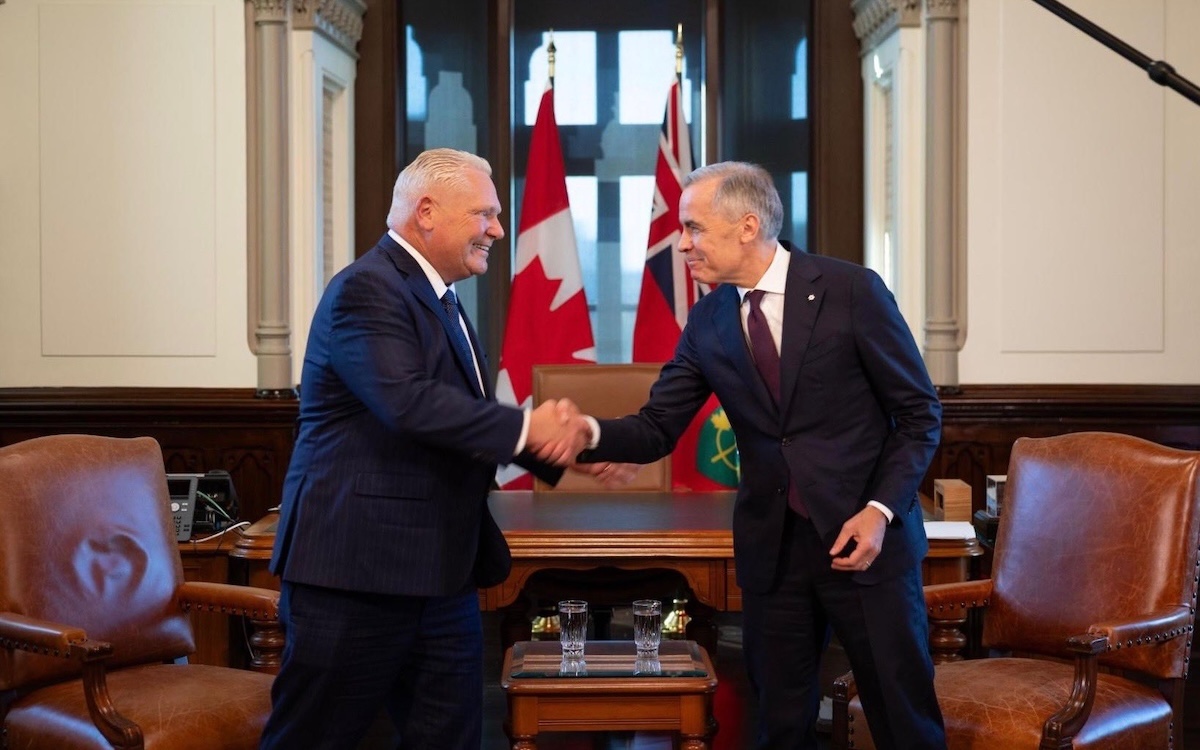
The federal government and the province of Ontario have created a total $9-billion plan to support, among other areas, the auto industry. Photo: X (formerly Twitter)/@MarkJCarney
Prime Minister Mark Carney and Ontario premier Doug Ford announced the measures in Ottawa, drawing mixed reactions from the auto industry and clean-energy advocates
Canada will maintain its fleet-average greenhouse gas emissions standard in light-duty vehicles at 2026 levels (172 grams per mile) through 2029, the federal government has announced.
The annual increases will resume in the 2030 model year, with the goal of achieving 75 per cent electric vehicle sales by 2035. That target is equivalent to a fleet-average emissions standard of 74 grams per mile.
“Maintaining the fleet average performance standard will provide manufacturers with near-term flexibility at a time when the industry is facing trade-related pressures,” reads the announcement, which was jointly released by Prime Minister Mark Carney and Ontario premier Doug Ford.
“It will also provide the ability to generate greenhouse gas credits for use in later years, while continuing to improve emissions performance and fuel economy over time.”
In addition to the revised emissions timeline, the federal and Ontario governments are investing $2.5 billion over two years to support large-scale automotive capital projects.
Seeking direction in a uncertain future
Industries across Canada have been anticipating the government’s announcement, which, many hoped, would bring a sense of direction, clarity and certainty to the future.
The announcement has drawn mixed reactions, with clean-energy organizations warning that delaying more stringent standards could undermine Canada’s EV ambitions.
“[T]he decision to pause any increase in the regulation until model year 2030 puts significantly more pressure on the policy’s later years and could undermine success down the road,” reads a statement from Clean Energy Canada.
“The unexpected delay will impact the potential benefits of stronger EV uptake, including thousands in fuel cost savings for households and up to $21 billion in charging industry investments. At the same time, Canadian communities will face the increased health costs and impacts from worse air quality.”
Some groups, such as the Pembina Institute, took even stronger positions on the freeze in meeting GHG emission regulation targets, questioning whether the government’s longer-term EV sales target remains achievable.
“Earlier this year, the federal government promised stronger vehicle pollution standards starting in 2027, but they are now delaying that to 2029,” reads a statement from the Pembina Institute.
“This makes its goal of 75 per cent EVs by 2035 next to impossible, delaying progress toward giving Canadians more affordable vehicle choices.”
Meanwhile, the auto industry is largely pleased with the longer timeline the federal government is providing for scaling up EV sales, arguing that a more predictable timeline will help protect Canadian jobs and investment.
“We welcome the measures to support Canada’s auto industry through this challenging period,” reads a statement from Brian Kingston, president and CEO of the Canadian Vehicle Manufacturers Association.
“Today’s announcement is an important step toward a more predictable, competitive, and achievable regulatory environment needed to protect Canadian auto jobs, production, and investment.”
Meanwhile, the Ontario Auto Mayors (a group of mayors across the province who oversee municipalities with auto sectors) released a statement thanking the government for “listening to industry concerns” with respect to freezing the emissions regulations.
No going back
In the joint announcement with Carney, Ford acknowledged that the U.S. midterm elections in November 2026 and the impending halfway point of Donald Trump’s presidency could be inflection points, but they would do little to reverse the changes already reshaping cross-border trade..
“As we stand here today, it’s clear that Canada’s relationship with the United States has changed permanently,” said Ford in his press conference remarks.
“No matter what happens in the midterms, no matter who sits in the White House, we’re not going back to the way things were, and we need to plan accordingly.”