Despite overall numbers, most provinces actually made gains in market share with the first year-over-year rise in more than 12 months

Despite overall numbers, most provinces actually made gains in market share with the first year-over-year rise in more than 12 months
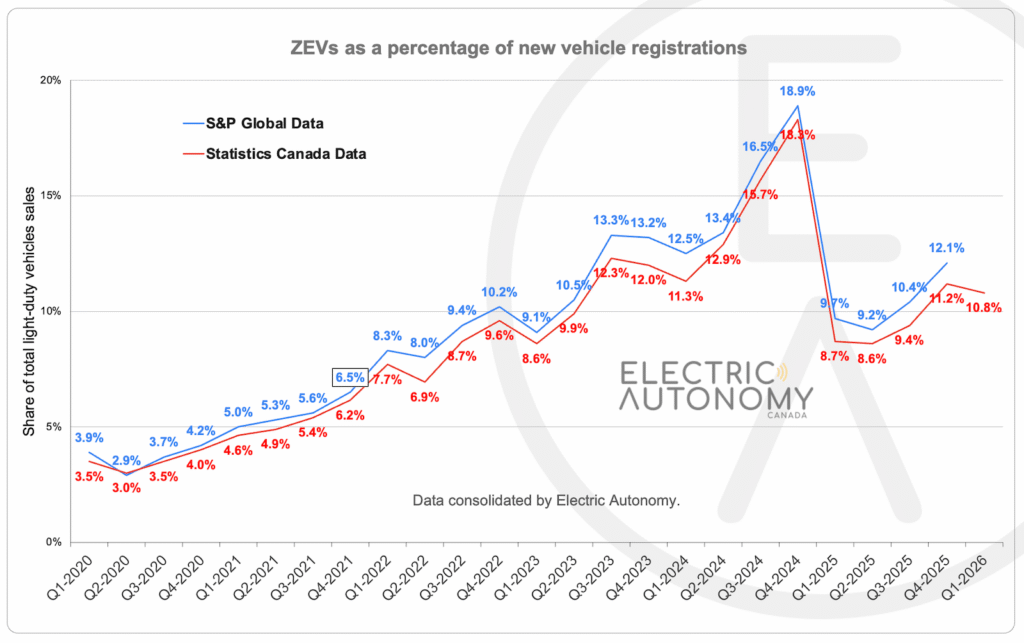
Canadian registrations of zero-emission vehicles (ZEVs) fell by just over half a percentage point to 10.8 per cent of total vehicle registrations in the first quarter of this year compared with Q4 2025, according to the most recent data from Statistics Canada.
That’s down from 11.4 per cent for the last three months of 2025.
Overall new vehicle registrations fell across the board, with a total of 397,601 for the first three months of 2026, compared with 412,746 registrations in Q4 last year.
Battery-electric vehicles (BEVs) made up 7.5 per cent (29,808) of total sales, with plug-in hybrid electric vehicles (PHEVs) making 3.3 per cent (13,305).
Total ZEV registrations for Q1 2026 were 43,113.
(Note: StatsCan classifies BEVs and PHEVs as “zero-emission vehicles.” This grouping does not reflect Electric Autonomy’s policy, which considers only non-combustion engine vehicles as zero-emission. However, where statistics refer to ZEVs, we have adhered to StatsCan’s definition for consistency.)
Some provincial optimism
Despite the overall numbers, most provinces saw a marginal uptick in ZEV market share. Manitoba had the largest jump, up to 7.7 per cent from 5.2 per cent last quarter. Prince Edward Island was the only other province to record a rise of more than a percentage point, up to 7.5 per cent from 6.2 in Q4.
Ontario — with the most overall vehicle registrations in the country at 153,497 — moved less than a percentage point up to 8.2 per cent ZEV market share for Q1.
Quebec, B.C. down
Traditional ZEV adoption powerhouses, Quebec and British Columbia, each saw a drop of two percentage points with their respective ZEV market shares. Quebec was down to 17.5 per cent in Q1 2026, while B.C. dropped to 19.1 per cent.
The Northwest Territories and Yukon also experienced a drop in ZEV market share quarter over quarter. NWT went down to 1.0 per cent in Q1 2026 from 1.2 per cent, while Yukon went to 6.5 per cent from 7.5 per cent in Q4 2025.
Nunavut failed to register a single ZEV in the first three months of 2026.
These five provinces and territories made up 141,531 of Canada’s total vehicle registrations, or 35.6 per cent, which dropped the country’s overall numbers.
Quarter over quarter, only hybrids gained traction in sales out of all vehicle types, which include gasoline, diesel, BEV, PHEV, hybrid and other fuel types, with 53,584 in Q1 2026 compared to 50,478 in Q4 last year.
StatsCan does not have figures for Alberta or Newfoundland and Labrador because of contractual limitations of the existing data sharing agreement. However, they are included in the Canadian totals.
Year-over-year rise
The country is marginally better for ZEV market share in Q1 2026 compared with Q1 of 2025, which saw an 8.7 per cent share. According to StatsCan, this growth marks the first year-over-year increase since the fourth quarter of 2024.
Despite the introduction of the Electric Vehicle Affordability Program (EVAP) and its ZEV incentives on February 16, however, ZEV registrations have been comparatively slow. Between the start of EVAP and April 30, StatsCan revealed in a dataset released previously that there were 24,391 incentive recipients for either BEVs or PHEVs.
We expect to see higher numbers in Q2 as the program gets more recognition.
Editor’s note: Q4 ZEV market share in the second paragraph has been updated by StatsCan since publication in March.
Data from Statistics Canada is compiled solely from new vehicle registration records from provinces and territories.
Electric Autonomy prefers quarterly sales data over monthly statistics to show a broader trend in sales, rather than individual spikes and valleys. Market share over sales numbers is also a better indicator of ZEV adoption in Canada.