Government incentives paid up to 80 per cent for 21 buildings, where load management software eliminated the need for electrical upgrades
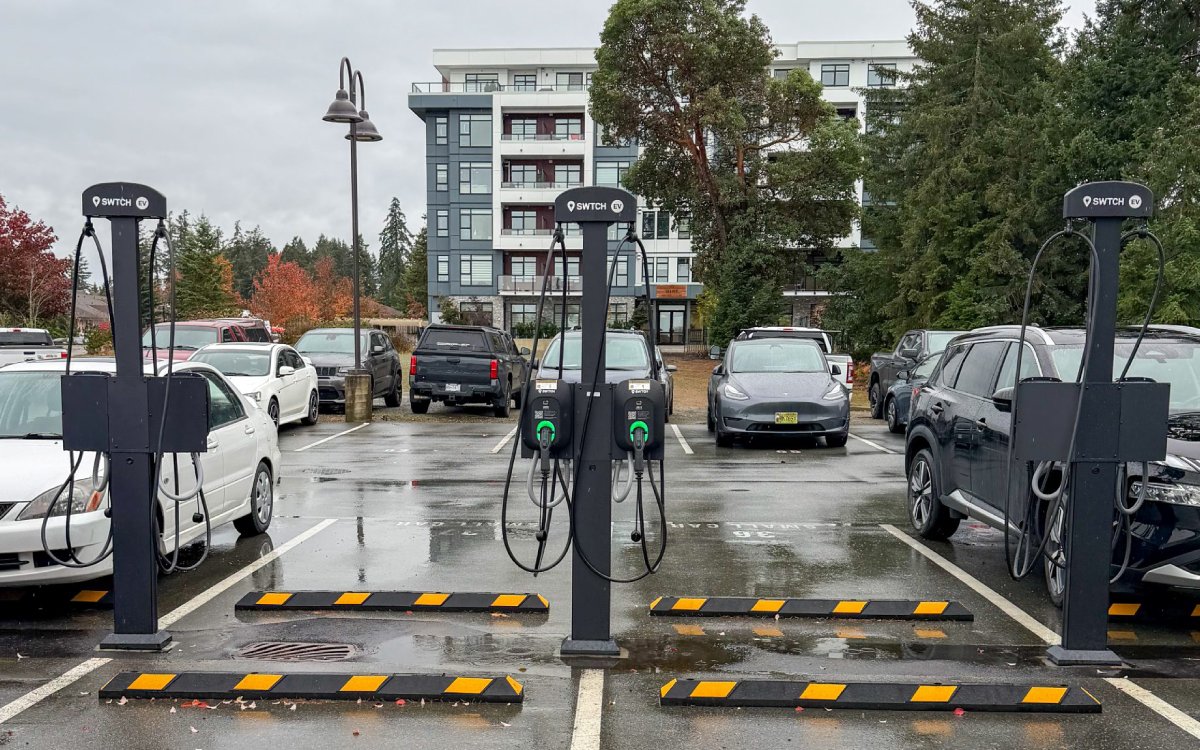
SWTCH installed more than 400 EV chargers at 21 existing residential buildings for Groupe Denux. – SWTCH
Government incentives paid up to 80 per cent for 21 buildings, where load management software eliminated the need for electrical upgrades
Toronto-based SWTCH Energy is on the cusp of finishing a major retrofit of EV charging infrastructure in 21 older multi-unit residential buildings (MURBs) across Canada. With more than 400 charger installations, the company says the project shows existing buildings can offer the at-home charging long associated with new condos and houses.
The rollout for family-owned landlord Groupe Denux, began about a year ago. Roughly 80 per cent of the chargers are now installed and running, said Ramsey Alfantazi, SWTCH’s business development manager for Western Canada, in an interview with Electric Autonomy.
Most of the buildings are in Nanaimo and Victoria on Vancouver Island. There are also a couple in Calgary, where installation is about to start, and one in Montreal, where final inspection is underway. The buildings average about 100 units, from three to four storeys and were built between the 1980s and 2020.
Dealing with electrical capacity
The biggest technical hurdle, Alfantazi said, was that many of the older buildings had limited electrical capacity. Rather than have the landlord pay for costly upgrades or run up demand charges, SWTCH employed its load-management software.
“The load management software on the building level throttles down the charges during peak times, and that that saved them a lot of money,” he said of the software called SWTCH Control.

Funding for the retrofits came mainly from Natural Resources Canada’s Zero Emission Vehicle Infrastructure Program (ZEVIP), stacked with BC Hydro incentives and the Écorecharge program in Quebec for the Montreal site. Combining the programs covered up to 80 per cent of total project costs in those areas, Alfantazi said.
The number of chargers in each building depended on available power and location. In one upscale downtown Victoria building, where residents are more likely to own an EV, every parking stall got a charger—about 40 in all. Older, more suburban buildings got shared setups.
Tenants pay only for the electricity they use.
Immediate results
Demand followed supply. Groupe Denux, which owns properties in British Columbia, Alberta and Quebec, treated the project as a five- to 10-year investment, but the returns showed almost immediately.
“They were really looking to future proof,” said Alfantazi. “They didn’t have the demand for that amount. A lot of the buildings only had two or three chargers, and then after install, suddenly there are 10 EVs in the building.
“It just shows that if you put [chargers] in, people will come, especially in a rental-building type of scenario. It helps to paint the picture of why [installing EV charging] would be a no-brainer, especially when you are getting 80 per cent of the cost covered.”
Partners are key to success
Alfantazi said large, multi-site projects depend on outside partners. This project spanned different municipalities each with their own regulations and involved a variety of incentive programs, all of which proved challenging. SWTCH worked with consulting firm Exigent Endeavors and Osprey Electric, which is handling installation.
According to Statistics Canada, about a third of households in the country are in MURBs, which makes it difficult for those people to access less-expensive EV charging at home if it’s not already part of on-site parking.
It’s a problem Alfantazi knows only too well. He said he joined SWTCH after living in an older building as an electric vehicle owner and having to rely on public fast chargers. It was so inconvenient he considered selling the car before finding another apartment with charger access.
“It makes it extra special when you can deploy something like this,” he said.