New network to span a 2,222-km route through three countries with megawatt chargers and hydrogen filling stations

The British Columbia to Baja California ZEV Corridor (BC2BC) will go from Vancouver to the Baja peninsula in Mexico. – iStock
New network to span a 2,222-km route through three countries with megawatt chargers and hydrogen filling stations
The government of British Columbia joined three U.S. states and a Mexican state in a partnership to develop a zero-emissions trucking corridor down the west coast of North America.
The project, called the British Columbia to Baja California ZEV Corridor (BC2BC), was announced on Wednesday in Long Beach, Calif. Baja California in Mexico, along with the U.S. states of California, Oregon and Washington are also part of the commitment.
The initial buildout of BC2BC will include 20 charging stations with a minimum of 2.5 MW and three hydrogen filling stations from Vancouver down to the I-5 freeway and into Baja, one of the busiest freight corridors in North America. The infrastructure will be interoperable across jurisdictions with common standards.
Average daily truck traffic along the 2,222-km I-5 is nearly 10,000 trucks, sometimes rising to as many as 35,000 per day.
Partnerships are critical
No investments from governments were disclosed. The California State Transportation Agency, the UC Davis Institute of Transportation Studies and CALSTART (a non-profit organization dedicated to progressing the adoption of clean transportation) are coordinating planning and public investment for the project.
“With global fuel prices driving up the cost of moving goods, partnerships like this are more critical than ever to strengthen our economies and … zero-emission transportation goals,” said California Transportation Secretary Toks Omishakin in a statement.
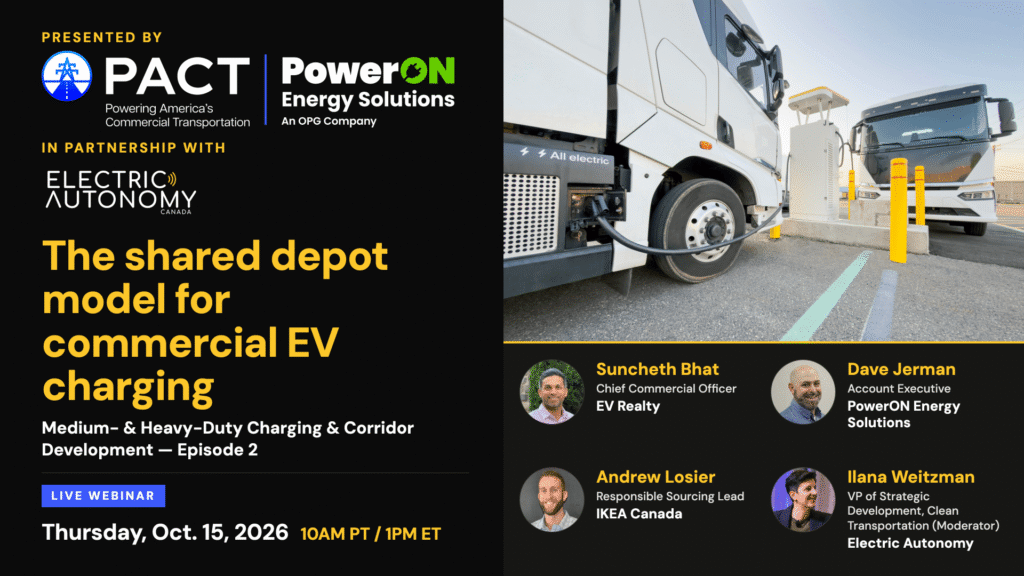
Join PowerON Energy Solutions, EV Realty and IKEA Canada on October 15, 2026
In this live discussion, ask your questions to organizations developing shared charging hubs to service medium- and heavy-duty electric fleets.
The next steps will be a series of technical meetings among the five governments to coordinate guidance, technical standards and planning.
According to a press release, the five governments plan to define other charging corridors across North America, establish a framework for promoting BC2BC, form a dialogue to sustain ongoing work on the charging infrastructure and promote private sector uptake of zero-emission medium- to heavy-duty vehicles (ZE-MHDV), and share the building and technical resources with other entities looking to expand their own ZE-MHDV infrastructure.
‘Real operational value at scale’
Volvo Group North America, Southern California Edison, Tesla, EV Realty and King Fio Trucking participated in the launch, with zero-emission trucks from IMC Logistics, Volvo, Tesla and ZM Trucks on display.
“Freight corridors are where electrification can deliver real operational value at scale,” said Aravind Kailas, advanced technology policy director for Volvo Group North America, in a press release.
“By aligning charging infrastructure, technical standards and planning across jurisdictions, the BC2BC initiative can give fleets greater confidence to plan routes, maintain uptime and make long-term investment decisions.”
BC2BC operates under the Global Green Road Corridors (GGRC) initiative, which focuses on decarbonizing major MHDV trade routes between ports and industrial hubs around the world. GGRC falls under the CALSTART umbrella of projects.