Plug-In Fleet Heavy Equipment initiative will monitor and document performance data over a three-year period for future fleet electrification
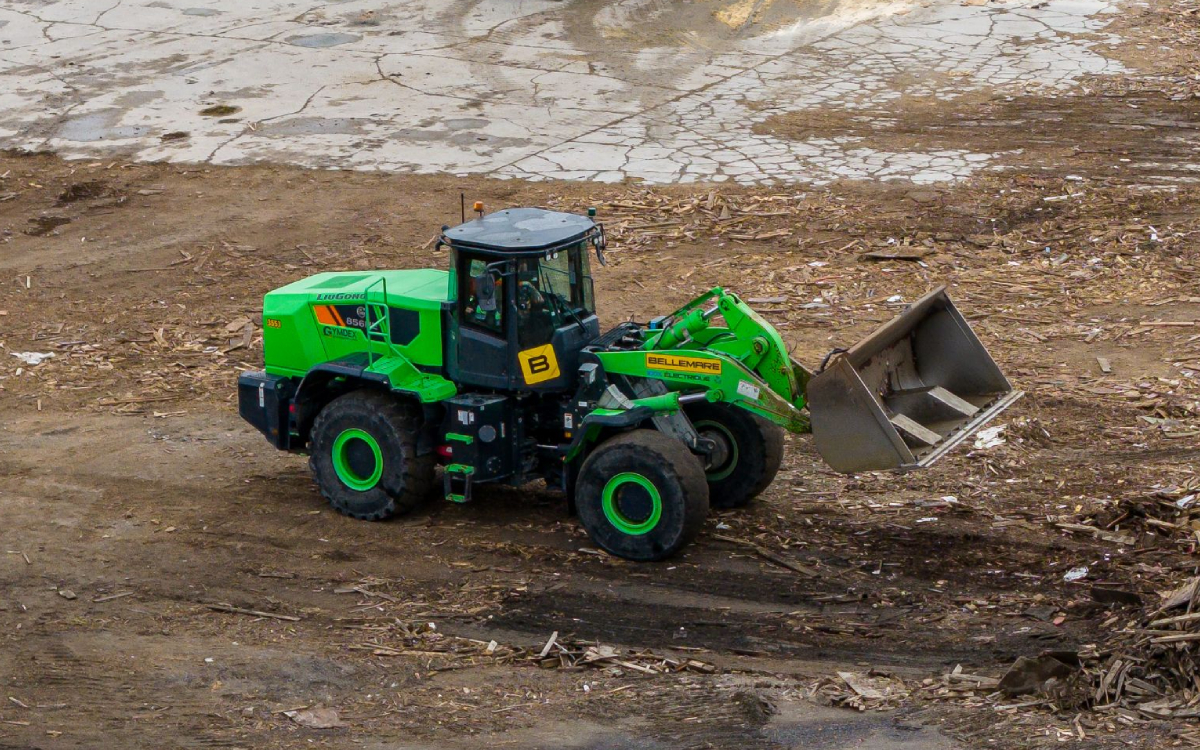
Groupe Bellemare in Trois-Rivières, Que., operates four LiuGong heavy loaders made in China. – Groupe Bellemare
Plug-In Fleet Heavy Equipment initiative will monitor and document performance data over a three-year period for future fleet electrification
Operating electric heavy loaders is paying big benefits for a Quebec transport and construction company and its ongoing participation in a testing program will hopefully pass on lessons to other companies looking to electrify.
Groupe Bellemare, in particular its abrasives and minerals division, has saved hundreds of thousands of dollars in diesel and maintenance costs using electric heavy loaders since it began with electric equipment in 2024.
In 2025, it partnered with the Institut du véhicule innovant (IVI) on a three-year program called Plug-In Fleet Heavy Equipment to test and document the equipment’s performance.
Real-world data
IVI is a non-profit technology transfer centre affiliated with Cégep de Saint-Jérôme, a Quebec college in Saint-Jérôme, Que. It helps develop and test new, cleaner technologies for transport, and though it is not a government entity, it runs the heavy equipment program for the Quebec government under the Action-Climat Québec program.
Project manager Martin Roy said the goal of the program is to train contractors on electrification and collect data on electric heavy equipment in a real-world environment. That data will be shared with the public to help education about the benefits of electrification and help those who want to transition their own fleets.
Roy said many in the industry are often surprised that a 20-tonne electric loader can work for hours on a single charge.
“Yes, in 2026, we are on that level,” said Roy.
Early adopters
Bellemare’s procurement manager, Sasha Bellemare, and its abrasives operations manager, Jason Lagacé, are firm converts to electrification.
Groupe Bellemare, based in Trois-Rivières, was already operating some of the earliest electric wheel loaders in Canada when they were put into service in March 2024. It now has a Class 8 electric truck for short hauls (which is not involved in this program) and operates four electric heavy loaders and an excavator.
Because they already had the equipment in real-world applications, Groupe Bellemare’s role within the IVI project was to share operating data, performance information, lessons learned and practical experience from the field.
‘Operating costs are almost nil’
Lagacé said cutting expenses was the main motivation for going electric in the first place and rising fuel prices have since made the decision look better.
With just the four loaders, Bellemare estimates the company has spent about $54,000 for roughly 15,000 hours of electricity costs. Diesel machines would have burned an estimated $423,000 in fuel over the same period, giving the company an 87.2 per cent drop in fuel expenses.
“Operating costs are almost nil,” Lagacé says.
The loaders are made by LiuGong, a Chinese brand. Lagacé was unfamiliar with the manufacturer and initially skeptical but is now won over.
“It was a big risk,” he said, but the machines have “really surprised us so far. … Breakdowns have been almost negligible.”
Another benefit of no emissions
Maintenance savings are also significant. While the electric loaders still need occasional oil changes for their transmissions, the diesel machines need frequent engine and transmission fluid changes. They also go through particulate filters and diesel exhaust fluid (DEF), which raises costs significantly.
Operators like the quiet operation as opposed to the diesel engines and finish shifts less tired, Lagacé says.
As it has no exhaust, one loader works indoors at a plant that dries and sorts recycled glass, moving lighter material over short distances. Crews work 12-hour shifts, plugging in for half an hour at noon.
Lagacé said IVI’s engineers have supplied detailed operational reports that have helped see the value of electric equipment.
“It’s been really eye-opening,” he said.
Bellemare plans to electrify the heavy equipment fleet in its abrasives and minerals division, keeping one diesel machine on standby for power outages. Long-haul trucks will have to wait, he said, because battery range is still too limited.
The Plug-in Fleet Heavy Equipment testing program will end in 2028.