BEVs lead the segment with a rise to 8.0 per cent market share, while commercial EVs see a major jump in sales
BEVs lead the segment with a rise to 8.0 per cent market share, while commercial EVs see a major jump in sales
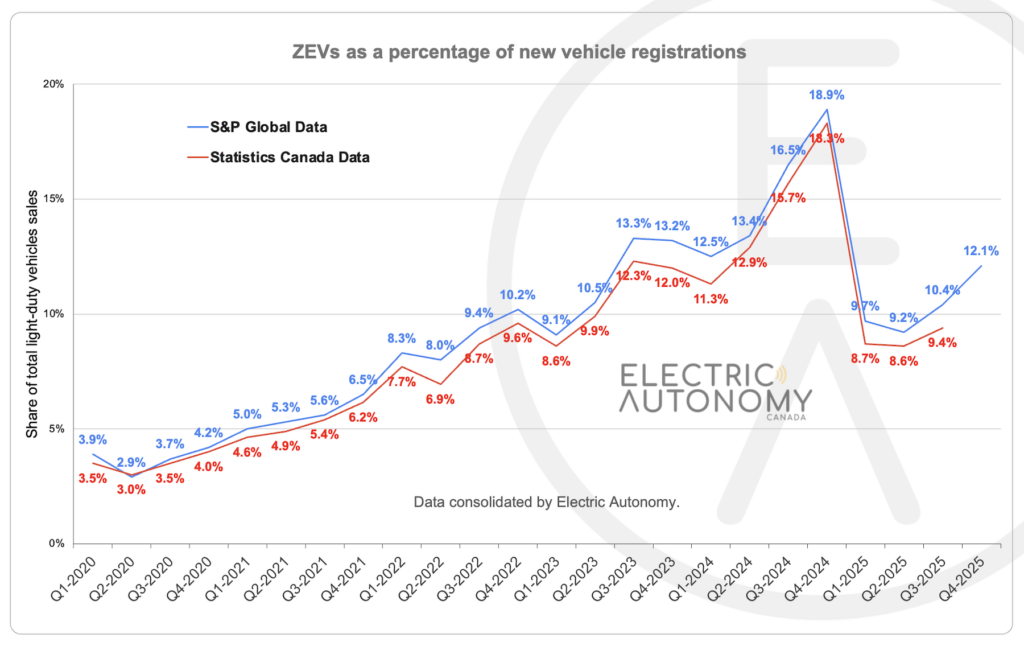
S&P Global Mobility’s auto market data for Q4 2025 reveals another quarterly rise in zero-emission vehicle (ZEV) registrations, with battery electric vehicles (BEVs) leading the way.
From a 6.3 per cent market share in Q3, BEVs jumped to a full 8.0 per cent resulting in a 1.7 percentage point increase. That carried the ZEV segment, which also includes plug-in hybrid electric vehicles (PHEVs), to 12.1 per cent market share overall, with the same 1.7 percentage point increase.
PHEV market share dropped slightly, from 4.2 per cent in Q3 to 4.1 per cent in Q4.
(Note: S&P Global Mobility, like Statistics Canada, classifies BEVs and PHEVs as “zero-emission vehicles.” The grouping does not reflect Electric Autonomy’s view, which considers only non-combustion engine vehicles to be zero-emission. However, where statistics in this report refer to ZEVs, we have adhered to the S&P Global Mobility definition for consistency.)
B.C., Quebec lead the provinces
British Columbia led the provinces in ZEV market share with a big jump to 22.5 per cent in Q4, up from 16.7 per cent in Q3. Quebec finished Q4 with 21.3 per cent market share, up from 20.2 per cent in Q3.
While Ontario — Canada’s most populous province — makes up around 40 per cent of new-vehicle sales in the country, it had just 7.7 per cent market share of ZEVs in provincial sales in Q4. The much smaller markets of Yukon Territory and Nunavut had larger EV market shares with 9.4 per cent and 8.9 per cent, respectively.
Continuing the trend from Q3, this last quarter saw hybrids gain further market share. The segment went from 16.9 per cent in Q3 up to 17.5 per cent in Q4. Over the course of 2025, hybrids grew to take up 31.3 per cent overall market share in Canada.
Significant jump for commercial EVs
Some segments of medium- and heavy-duty electric vehicles saw a significant jump in market share year-over-year.
Zero-emission Class 3 vehicles — primarily short-haul delivery vans — more than doubled its market share to 108.4 per cent, from 509 new units sold in 2024 to 1,061 vehicles last year.
And for Class 8 vehicles — heavy-duty, long-haul trucks — ZEV volume grew 84 per cent, from 275 vehicles sold in 2024 up to 506 units last year.
Market ebbs and flows
The rise in quarterly passenger and commercial ZEV sales is good news for the segment after a tumultuous year, including the pause of the Incentives for Zero-Emission Vehicles (iZEV) program in January, 2025.
Year-over-year, 2025 saw a 31.9 per cent decrease in passenger ZEV market share, down to 10.3 per cent from 15.4 per cent in 2024. However, those numbers are somewhat misleading, as the last quarter of 2024 saw a considerable spike in ZEV purchasing after the government’s announcement of the imminent cancellation of iZEV, with consumers rushing to take advantage of disappearing rebates.
Notably, the rise of the 2025 ZEV market share has occurred in the absence of any federal rebates. A new incentive program, the Electric Vehicle Affordability Program (EVAP), went live this month, offering $5,000 for a BEV and $2,500 for a PHEV for purchases as far back as February 16.
“In stark contrast to the hybrid surge, the ZEV segment experienced a major market correction, driven primarily by the pause or pullback of key federal and provincial incentive programs. The removal of these rebates fundamentally altered the financial equation for many consumers,” reads the report.
StatsCan will release its EV market share numbers next week.