Campaign aims to codify inconsistent provincial and municipal regulations to help the one-third of Canadians living in multi-unit buildings gain access to home EV charging
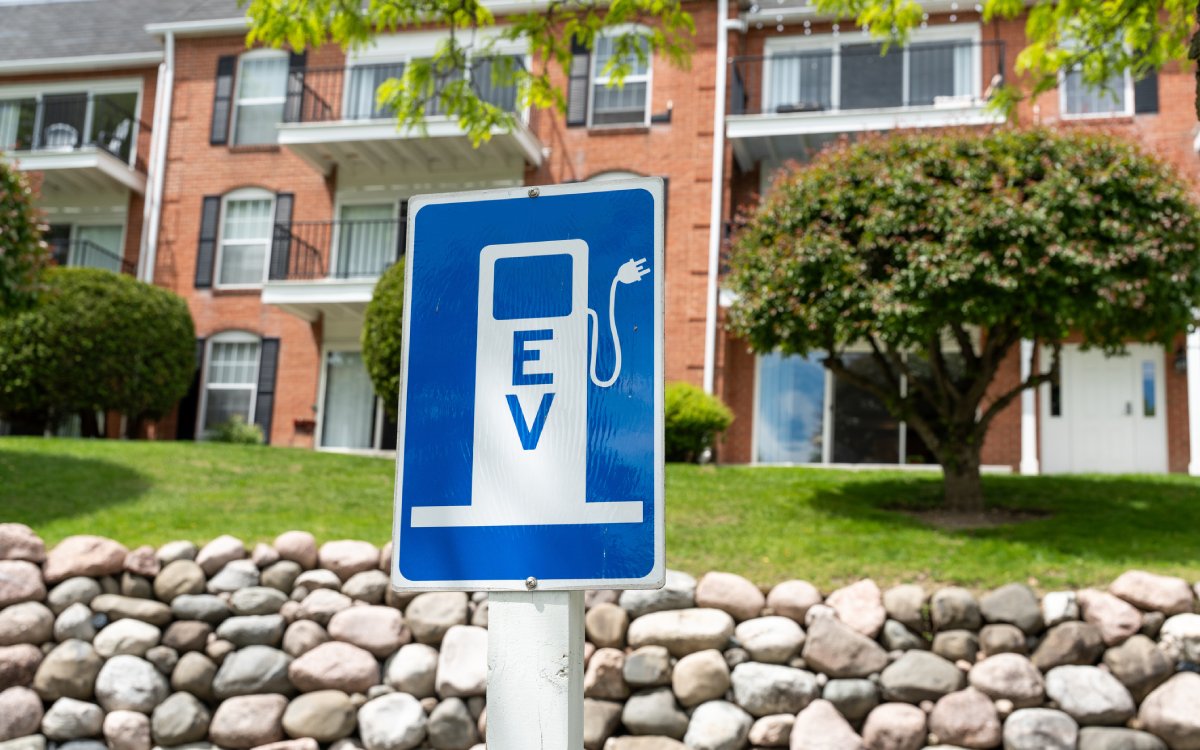
Around one-third of Canadian households live in multi-unit buildings, where accessing EV charging can be more difficult than in detached homes. – iStock
Campaign aims to codify inconsistent provincial and municipal regulations to help the one-third of Canadians living in multi-unit buildings gain access to home EV charging
Electric vehicle industry groups are calling on the federal government to triple the number of parking spaces in Canadian apartment and condo buildings that are ready for EV charging, saying people without a driveway are being shut out of the savings that come with driving electric.
The Canadian Charging Infrastructure Council (CCIC) and Electric Mobility Canada (EMC) launched the national campaign today at EMC’s EVVE 2026 conference in Winnipeg with an open letter to Prime Minister Mark Carney; Minister of the Environment, Climate Change and Nature Julie Dabrusin; Minister of Industry Mélanie Joly; and Minister of Housing and Infrastructure Gregor Robertson.
“Canadians should not need a driveway to benefit from the affordability of driving electric,” said Travis Allan, president and CEO of the CCIC.
An achievable goal
The groups’ letter asks Ottawa to set a national target to triple the number of EV-ready and charger-equipped spaces in multi-unit residential buildings (MURBs); to create a coordinated funding program to support studies, offer incentives for new construction and retrofit existing buildings; and to add EV-ready requirements to the national model building codes.
About one-third of Canadian households live in MURBs, where installing a home charger can be far more difficult compared to a detached house. The groups cite International Energy Agency figures showing about 80 per cent of EV charging in Canada happens at home.
Allan said tripling EV-ready parking is an achievable goal, “but only if there is a commitment to coordinated, collective action from the federal government, provinces and the charging industry.”
That, says Allan, requires the federal government to set national building codes that incorporate EV charging requirements as well as replicating what B.C. and Quebec have done in funding retrofitting programs for existing buildings.
“It’s much less about mandating and it’s much more about putting in place the tools and systems that allow for widespread electrification in condos and apartments,” says Allan.
Daniel Breton, president and CEO of Electric Mobility Canada, stresses that available home charging for everyone will help expedite the adoption of electric vehicles across the country.
“Once we have taken care of home charging, owning and operating an EV becomes much easier, much more efficient and even more affordable for Canadians,” said Daniel Breton, president and CEO of Electric Mobility Canada.
Savings for drivers, building owners
The groups point to an analysis by Clean Energy Canada that estimates a typical driver could save between $23,000 and $32,000 over 10 years with an EV compared with a gas-powered vehicle.
They also cite research by Dunsky Energy + Climate Advisors that found wiring an entire building for charging and using energy management systems could cost roughly $4,240 per parking space in net present terms. Adding chargers one at a time costs about $6,290 per space — roughly 48 per cent more.
Varying legislation
The National Building Code of Canada, a construction standard issued by the National Research Council Canada, is not enforceable legislation unless put into law by a province or territory.
Provinces and territories hold primary authority over building construction regulations. Municipalities can enact construction laws that are stronger than provincial legislation so long as they do not override existing provincial law.
As such, the rules governing charging in apartments and condos vary widely depending on where people live.
British Columbia and Quebec are the only provinces with EV-ready legislation. More than 60 municipalities across Canada have their own requirements for new buildings, including 33 in B.C. and 17 in Ontario.
There are no EV charger requirements for multi-unit residential buildings at either the provincial or municipal level in Manitoba, Saskatchewan, the Maritime provinces or the three territories.
Support across industries
Environmental groups, utilities and charging companies have thrown their support behind the initiative.
“Access to home charging is unequal in Canada, with many apartment dwellers not having the option to plug in at home,” said Rachel Doran, executive director of Clean Energy Canada. “Measures that get more charging stations into condos and apartment buildings will unlock the cost-savings and convenience EVs provide for more Canadians, including those who would benefit the most.”
The Electricity Distributors Association, which represents local utilities, backed the goal but said funding and planning will need to line up with the grid upgrades required to serve new charging demand safely and reliably.
The CCIC and EMC say the push supports Canada’s goal of reaching 75 per cent new electric vehicle sales by 2035.