Vehicle segment is a popular and practical choice among families who want to drive electric and avoid the minivan

The 2027 Toyota Highlander EV will go on sale in Canada in Q4 of 2026. – Toyota Canada
Vehicle segment is a popular and practical choice among families who want to drive electric
Recently, Electric Autonomy Canada was invited to see the upcoming 2027 Toyota Highlander EV up close and in person just outside of Quebec City.
Arriving in the later part of this year, the all-electric, mid-sized, three-row SUV joins a growing list of similar vehicles in a segment that is becoming popular on dealership floors and Canadians’ driveways.
The electric mid-size, three-row segment is second only to compact battery-electric SUVs when it comes to model choice here in Canada.
First Toyota with V2L
“This is our first three-row electric SUV and the first mass market Toyota BEV that will be assembled in North America,” said Scott MacKenzie, director of corporate strategy, planning and external affairs, in an interview with Electric Autonomy.
“It’s also the first Toyota model to feature vehicle-to-load technology.”
Replacing the minivan
The three-row SUV segment is replacing the traditional minivan for many families. They boast six or seven seats, all-wheel-drive capabilities (in most cases) and long lists of safety and convenience features.
The options range from mainstream SUVs to more upscale — and more expensive — premium vehicles.
It’s unknown where the Highlander will fall on that spectrum.
Two available batteries
Toyota hasn’t released pricing (or exact availability) yet, however, they say Canadians will have a choice of four trim levels including XLE, XLE AWD, XLE Premium AWD and Limited AWD.
The XLE is available in front-wheel drive with a 77.0 kWh battery and a range of 458 km. The all-wheel-drive version will have 431 km of range, or 511 km with the optional 95.8 kWh battery.
The XLE Premium AWD and Limited AWD will come with a 95.8 kWh battery as standard and a range of 473 km.
Every Highlander will be equipped with a NACS charging port and feature V2L technology. They will be built in Georgetown, Kentucky, with the batteries coming from Liberty, North Carolina.
An important niche
MacKenzie said Toyota is focused on filling important vehicle segments with fully electrified options. The Japanese automaker already has a compact SUV in the bZ, a slightly larger and more rugged version with the BZ Woodland, and a subcompact SUV in the C-HR. The Highlander would fill the final important niche for the brand.
“I don’t think you’ll see a scenario where we’re developing EVs for segments that are on the fringes,” he said.
The range of mid-sized, three-row SUVs in Canada is up to seven and increasing further. Here are the ones we can purchase now:
| Vehicle | Starting Price | Batteries | Range (NRCan) |
| Kia EV9 | $62,321 | 76.1 kWh and 99.8 kWh | 370 km, 491 km |
| Hyundai Ioniq 9 | $63,136 | 110.3 kWh | 539 km |
| Cadillac Vistiq | $96,643 | 102 kWh | 491 km |
| Volvo EX90 | $110,000 | 111 kWh | 499 km |
| Lucid Gravity | $113,500 | 89 kWh | 542 km |
| Tesla Model X | $149,990 | 100 kWh (Tesla doesn’t publish exact figure) | 566 km |
| Rivian R1S | $152,107 | 92.5 kWh, 108.5 kWh, and 140 kWh | 435-676 km |
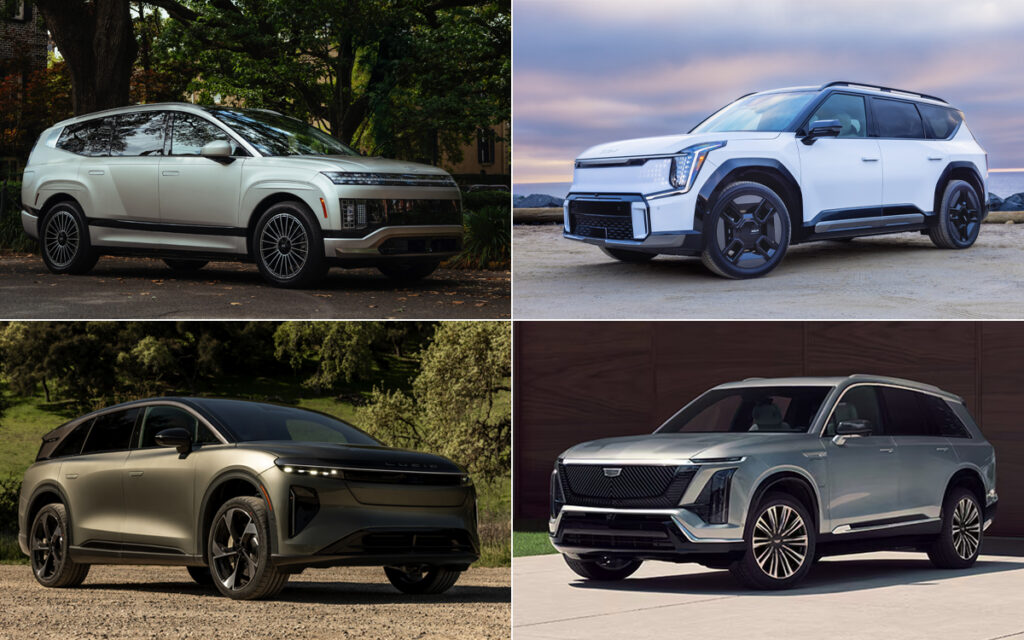
Along with the Toyota Highlander, expect to see these two battery-electric SUVs share the segment soon.
The Lexus TZ will be based on the Highlander EV, so it’s expected to have similar specs.
| Vehicle | Date of arrival | Estimated starting price | Battery | Range |
| Lexus TZ | Late 2026 (2027 model) | $80,000 | 77 kWh / 95.8 kWh | Up to 480 km |
| Genesis GV90 | Debuts Sept 9, 2026; Canadian sales likely early-mid 2027 | $120,000 | 115 kWh (estimated) | 500 km (estimated) |