New chapter of the non-profit Association for Uncrewed Vehicle Systems International is intended to bolster the country’s investment and manufacturing sector
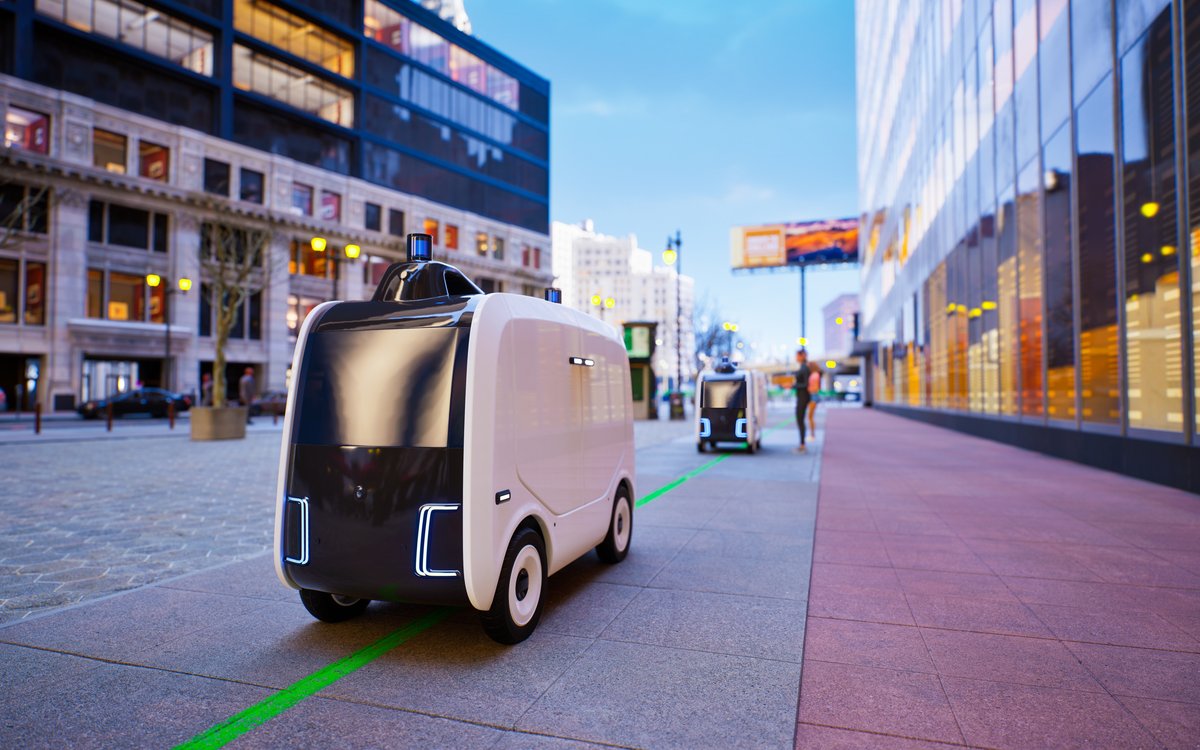
Autonomous delivery robot driverless on street, Smart vehicle technology concept, 3d render
New chapter of the non-profit Association for Uncrewed Vehicle Systems International is intended to bolster the country’s investment and manufacturing sector
A new chapter of a non-profit advocacy group is aiming to advance autonomous vehicle policy and manufacturing in Canada.
The Association for Uncrewed Vehicle Systems International (AUVSI) Maple Canada chapter is now live and accepting new members.
AUVSI was first formed in the U.S. in 1972, originally known as the National Association of Remotely Piloted Vehicles (NARPV). Today, the non-profit organization includes more than 400 organizations and 7,000 professionals in defence, civil and commercial industries worldwide. Its aim is to bring together industry leaders, policy makers, suppliers and manufacturers together to advance the autonomous vehicle industry, which includes passenger and freight vehicles, military and civilian drones, and even robotics.
Mapping the supply chain
The Maple Canada chapter began last month headed by Zeeshan Qadri, the global marketing manager for Litens Automotive Partnership. He’s also the co-chair for the E-Mobility Council for the Automotive Parts Manufacturers’ Association (APMA) in Canada.
With that experience, Qadri has a unique perspective on the automotive supply chain in Canada. With the country’s automotive sector in flux from changing U.S. policies, and with countries like China leading the global autonomous tech sector, he says Canada can pivot towards autonomous vehicles with a robust and cohesive supply chain.
“We’re trying to bring a whole ecosystem together. Autonomous systems are very similar when it comes to cars, robotics, or drones — same battery system, cooling system, sensors and all of that. The only thing is they are more compact.
“Our plan would be to map the supply chain and then identify the gaps, and that’s where we can provide reports and information … to take this forward,” he says.
Five objectives
Based at the the Centre for Integrated Transportation and Mobility (CITM) at the Innovation Factory in Hamilton, Ont., AUVSI Maple Canada has five main objectives:
- Advancing research and development through industry-academic collaboration.
- Enabling networking and ecosystem building across sectors.
- Supporting standards and best practices aligned with global frameworks.
- Providing policy input and advocacy to support the growth of the sector.
- Promoting talent development and strengthening the future workforce.
To reach those objectives, Qadri created four working councils to get the ball rolling. “We just don’t want this chapter to be a place where people come, meet and leave,” he said.
Municipal involvement
Municipalities in Canada lack a cohesive framework of regulations when it comes to autonomous vehicles, which has discouraged autonomous vehicle testing and deployment here.
Qadri says two municipal governments are already onboard AUVSI: the City of Vaughan, Ont., and the Niagara region in Southern Ontario. Qadri is also talking with other municipalities interested in signing up.
“AUVSI can provide [municipalities] a platform where all of them can come together, network, and come to a common ground when it comes to regulations and policies.”
Long-term goals
Qadri acknowledges there is a lot of work to do when it comes to building out a supply chain, gathering investment both in Canada and abroad, and getting governments onboard. But the AUVSI Maple Canada plan is long-term, and with the right people all pulling in the same direction, Qadri sees immense potential for Canadian industry.
“I don’t see Canada becoming big on autonomous systems in the next five years,” he says.
“But if we start now, starting from government to industry, and we start investing in it, then maybe in the next 10 years we can be on par with with the U.S., China and other jurisdictions.”
Click here for more information on joining the AUVSI Maple Canada chapter.