The key factors that affect charging uptime for fleets, and how the best operators reduce repair visits and improve cost efficiency

FractalEV finds that commercial charging is enabled by a working relationship with partners who can provide systems insight and continuous improvement. – iStock
The key factors that affect charging uptime for fleets, and how the best operators reduce repair visits and improve cost efficiency

Produced in partnership with FractalEV
There are many vendors in the EV charging infrastructure ecosystem that are eager to support a fleet, each with a spec sheet and a promise. The harder question is what truly separates a good reliability experience from a bad one.
As a charging manufacturer, FractalEV sees a significant range in performance on the exact same hardware. That means reliability is highly dependent on the partners a fleet chooses.
Many chargers were designed for the home and were never built for the rigours of a commercial site. Fleets should ensure they select chargers with a minimum of proper commercial metering (1 per cent accuracy), NEMA 4 enclosures and connectivity designed for reliable uptime.
Partners in a complex system
However, when you move beyond the specifications, a bigger picture emerges. Commercial charging is more than just a set of features: it is enabled by a working relationship with partners who can provide systems insight and continuous improvement. The real measure is consistent uptime without hand-holding, and the goal should be an experience where no support is needed.
EV charging is a complex system. Dispensing energy is often tied to an internet-based authorization step, meaning the charger must reach a server in real time and have its permissions verified before any power flows. Configuration, the characteristics of the use case and the wider system all affect whether that chain holds.
To test this, every configuration of Fractal Level 2 chargers in the field was evaluated by FractalEV for session success. Results ranged from roughly 65 per cent to 95 per cent, depending on the specific operator running Open Charge Point Protocol (OCPP, the protocol a charger uses to talk to its management software). That is a gap of about 30 points on identical hardware.
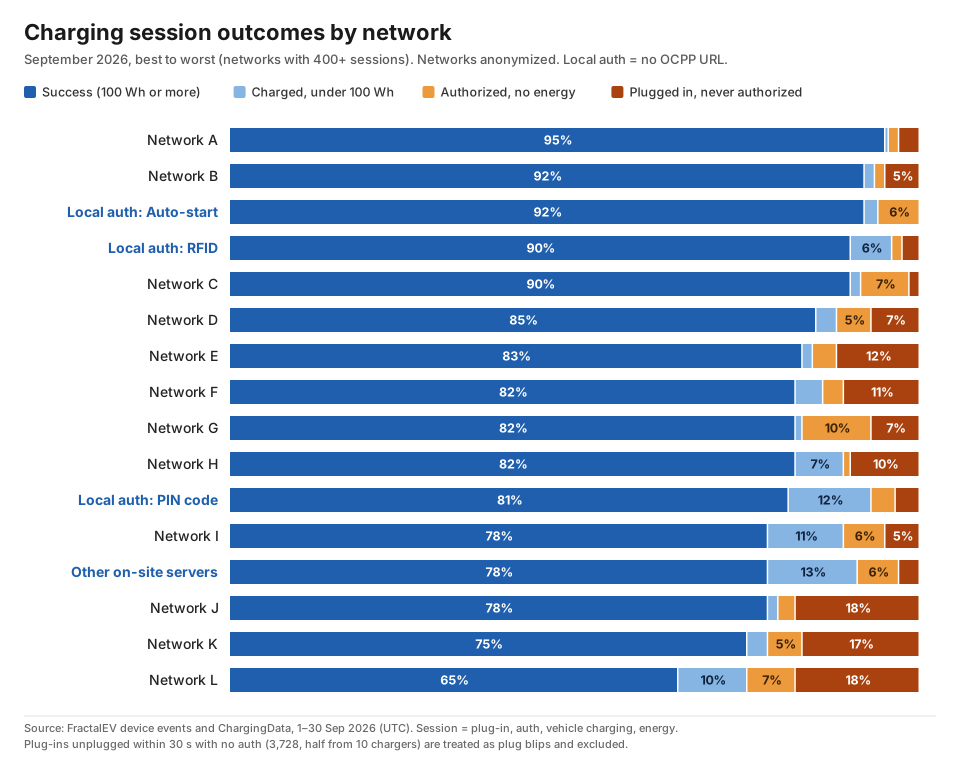
This gap carries two important lessons. First that the operator matters, because it can be the difference between a steady experience and major system downtime. And secondly that the best partners keep improving, which is dependent on collecting data from the field and acting on it.
Data drives progress
For that reason, a true commercial partner must be able to ingest field data and use it to make products more reliable over time. Chargers that are less expensive at first but are left in the field with no oversight from the manufacturer become unreliable. This is why many DC vendors (and FractalEV for AC) provide an OEM asset management tool, which allows continuous monitoring of each device.
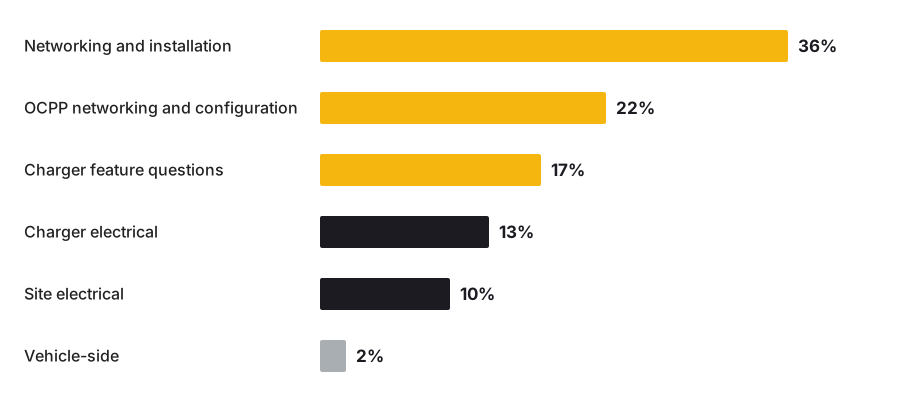
To go a layer deeper, every field issue that arose between January 2024 and October 2026 was monitored and categorized by FractalEV. Of these, about 75 per cent were networking, OCPP setup or feature questions, problems that can be fixed with a configuration change and not a truck. Another 23 per cent involved electrical issues at the charger or site, where collected data on voltage, temperature and ground help send the right person with the right part.
The difference remote access makes was measured as well. Across 286 real support cases, a modelled comparison with a similar OCPP-only charger showed about 51 per cent fewer site visits for Fractal chargers. In other words, roughly half of the trips were avoided by reaching the charger another way.
With non-commercial chargers, there is neither a system to observe these issues nor the tooling to fix them remotely. The only line of defence is an electrician on site, who can change settings but is unlikely to uncover the systemic IT issues behind most charging problems.
This is the context that sets high-reliability commercial charging apart. Hardware that meets the spec is expected, but the result that matters is delivered by systems insight, remote serviceability and steady improvement.
For that reason, the advantage of partnering with local, engaged suppliers is hard to overstate.
To learn more about commercial EV charging, reach out to FractalEV.