Ottawa announces sweeping changes that support Canadian electric vehicle manufacturing and sales, with $1.5 billion earmarked for charging infrastructure
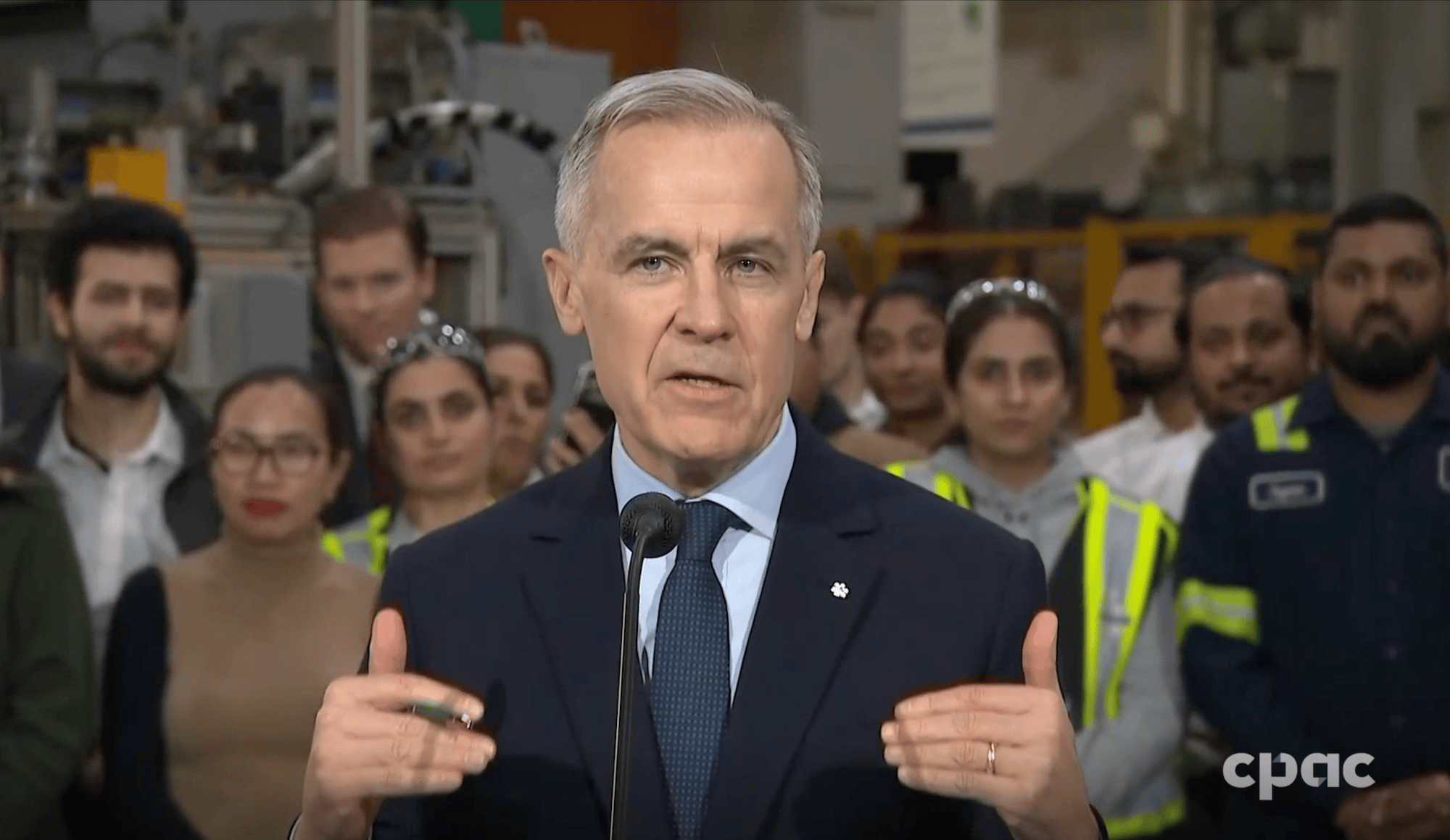
“A confident Canada is making the strategic decisions and the generational investments today to build the affordable, enjoyable and low emissions automobiles of the future,” said Prime Minister Mark Carney at a Martinrea International facility earlier today. Image: CPAC
Ottawa announces sweeping changes that support Canadian electric vehicle manufacturing and sales, with $1.5 billion earmarked for charging infrastructure
Prime Minister Mark Carney today announced the end of the Electric Vehicle Availability Standard (EVAS), signaling a landmark shift in Canada’s climate and transportation policy.
Going forward, EVAS will be replaced with more stringent greenhouse gas emission standards with a reduced goal of 75 per cent EV sales by 2035 and 90 per cent EV sales by 2040. Further details on how these standards will work have yet to be determined.
EVAS was introduced in December 2023 under the government of former Liberal prime minister Justin Trudeau. It required automakers to achieve ZEV sales targets incrementally, starting with 20 per cent of new light-duty vehicle sales in Canada by 2026, up to 60 per cent by 2030 and, finally, 100 per cent of all sales by 2035.
In December last year, Carney announced a temporary, 60-day pause on EVAS, in a bid to help the Canadian automotive sector compete under changing trade conditions.
A break from U.S. standards
Daniel Breton, President and CEO of Electric Mobility Canada, told Electric Autonomy that, while details of the GHG emissions regulations are few at this point, he is confident that developing Canadian standards is the best move forward.
“The truth is that the current [emission] regulation standard aligned with the U.S. has failed miserably, because between 2011 and 2023 GHG emissions from automakers’ vehicle fleets has decreased by only 1 per cent. So, we have to become a lot more ambitious if we want, like Prime Minister Carney said, to reach 75 per cent EV sales by 2035, which we find as a reasonable target.
“But we have to make sure that we stick to these targets, that we put in place regulation that’s stringent enough that it does not work in such a way that it’s only per vehicle, but it’s going to be per fleet.”
David Adams, the President and CEO of the Global Automakers of Canada, told Electric Autonomy that he was happy to have clarity on the EVAS subject, which had automakers’ lineup plans in limbo while the program was paused. But Adams sees a larger picture beyond the GHG standards.
“It’s easy enough to focus on the repeal of the EVAS,” said Adams. “But I think the larger issue for me is the continued demonstration that the Prime Minister is seized with not only maintaining, but … growing the manufacturing footprint here in Canada and maintaining the automotive industry — the employment, the indirect employment, the economic benefit that flows from having an automotive industry in Canada.”
Vehicle incentives return
At the announcement in Woodbridge, Ont., the government also said it is reintroducing EV incentives through a $2.3-billion investment into a five-year EV Affordability Program.
It will offer $5,000 for BEVs and $2,500 for PHEVs that cost up to $50,000 and are made by countries with which Canada has free trade agreements. This cost cap will not apply to Canadian-made zero-emission vehicles (ZEVs).
It is forecast that more than 840,000 electric vehicles will be incentivized over the five years of the program.
The rebates will be available from February 16, and decrease steadily until the end of the program (see table below).
| Vehicle type | 2026 | 2027 | 2028 | 2029 | 2030 |
| Battery electric and fuel-cell electric vehicles | $5,000 | $4,000 | $3,000 | $3,000 | $2,000 |
| Plug-in hybrid vehicles | $2,500 | $2,000 | $1,500 | $1,500 | $1,000 |
It’s been a year since the original Incentives for Zero-Emission Vehicles (iZEV) program was shuttered after funds were depleted from high demand.
iZEV offered up to $5,000 on eligible base-model BEVs under $55,000, or higher trims up to $65,000. For station wagons, light-duty pickup trucks, SUVs, minivans, vans or special purpose vehicles, the limit was $60,000 for base models and $70,000 for higher trims.
PHEVs were eligible for up to $2,500.
The program ended in January 2025 with 563,313 electric vehicles funded through the system for a total of more than $2.6 billion. According to a report this week by the Canadian Climate Institute, EV sales dropped nearly 60 per cent after federal rebates ended.
Charging infrastructure funding
The government’s approach with the new funding streams aims for a holistic strategy with multiple facets of the auto industry and its ancillary sectors being supported.
On the infrastructure side, the government says it is earmarking $1.5 billion to expand EV charging stations across the country through Canada Infrastructure Bank’s (CIB) Charging and Hydrogen Refueling Infrastructure Initiative.
This will be a part of a national charging infrastructure strategy to be announced in the coming weeks. It is set to include the involvement of private equity, reducing barriers to building charger networks, making buildings EV-ready and bolstering skills training.
Travis Allan, President and CEO of the Canadian Charging Infrastructure Council (CCIC), told Electric Autonomy the funds provided for the CIB are instrumental for private companies in building out Canada’s charging infrastructure.
“For charging companies that are making multi-year infrastructure investment decisions, the certainty of these regulations is going to be fundamental for them to justify the billions and billions of dollars that are going to be needed to build these charging projects,” said Allan.
“If this package is implemented as outlined, it is likely to catalyze billions of dollars in electric vehicle charging investment in Canada to help meet the targets of 75 per cent EV sales by 2035 and 90 per cent by 2040. So that’s really good news for Canadian jobs in the civil and electrical trades.”
Help for Canada’s workers
The announcement also included support for Canada’s auto and climate sector, including up to $300 billion to help the auto industry adapt to changing markets, reducing corporate tax rates for zero-emission technology manufacturers, maintaining counter-tariffs on the U.S. and deepening partnerships with South Korea and China.
Finally, a Work-Sharing grant is aimed at preventing layoffs, while the forming of a new alliance between labour, industry and training partners is meant to “address bottlenecks and catalyze private investment.”
A $570-million investment will provide employment assistance for up to 66,000 workers across Canada whose jobs have been affected by tariffs and global market changes.
Overall, Breton of Electric Mobility Canada is confident with the direction of the policy announcement.
“The star of the show is that the government understands that the future is electric and that it’s not necessarily going to be easy,” said Breton. “But the truth is that I feel Canada is at the crossroads now … Prime Minister Carney recognizes that, and he says, ‘We have to find new partners to work with, and auto manufacturing with other countries or other jurisdictions.’
“I think to me, the main takeaway is that we can’t follow the U.S. anymore. We have to go our own way.”
Full details are available on the Innovation, Science and Economic Development Canada website.