A new survey suggests 52 per cent of respondents want the government to keep the policy, including 32 per cent who support it with some modifications
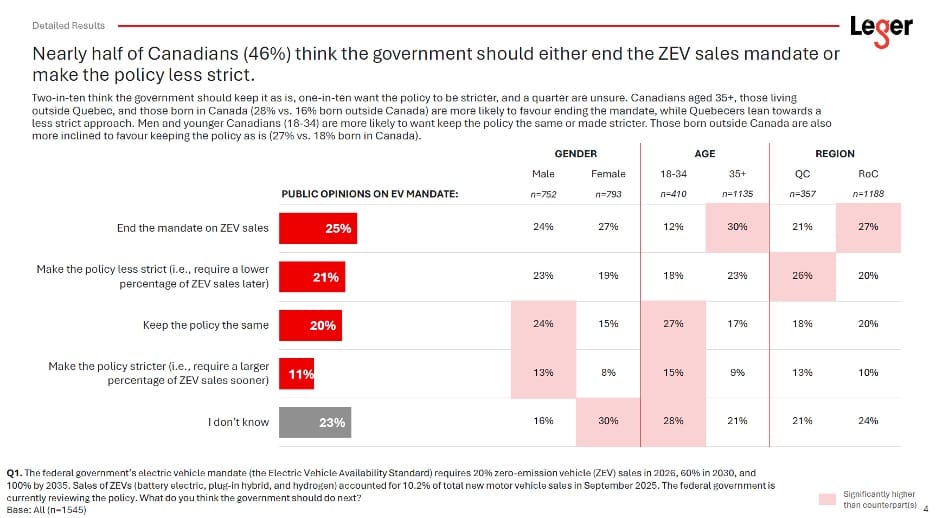
According to the survey, 20 per cent of respondents want the mandate to remain the same, 21 per cent said they would prefer the policy to be less stringent, while 11 per cent want the mandate to be more ambitious. Photo: Leger
A new survey suggests 52 per cent of respondents want the government to keep the policy, including 32 per cent who support it with some modifications
A new poll finds that 52 per cent of Canadians want the federal government to maintain the country’s Electric Vehicle Availability Standard (also known as the EV sales mandate), though many favour changes to how it is implemented.
The survey was conducted by Leger on behalf of the Canadian Vehicle Manufacturers’ Association (CVMA), the Global Automakers of Canada (GAC) and the Canadian Automobile Dealers Association (CADA). It asked a series of questions to more than 1,500 Canadians between Nov. 21 and 24, 2025, using an online panel.
The federal EV sales mandate was introduced to improve the availability of new electric vehicles nationwide by setting annual targets for the share of new vehicle sales that must be electric, relative to internal combustion engine vehicles.
In September, the government paused the interim target of 20 per cent of all new light-duty passenger vehicles being zero-emission by 2026. The mandate is currently under review.
Poll findings
According to the survey, 20 per cent of respondents want the mandate to remain the same, 21 per cent said they would prefer the policy to be less stringent, such as by requiring lower ZEV sales targets or delaying timelines, while 11 per cent want the mandate to be more ambitious by increasing sales targets sooner.
At the same time, 25 per cent of respondents said they want the mandate scrapped altogether, and 23 per cent said they were unsure.
Support for the mandate varies by age and region. Canadians over the age of 35 and those living outside of Quebec were more likely to favour ending the policy, while respondents aged 18 to 34 were the most supportive of the mandate, including options to make it more ambitious.
These findings are broadly aligned with a poll from Clean Energy Canada, conducted in June 2025 with 2,585 Canadians.
Results from the Clean Energy Canada summer poll found that 66 per cent wanted the mandate kept in place or adjusted, while 27 per cent opposed having any mandate, and eight per cent said they did not know.
Additionally, 46 per cent of respondents said they would support a revised standard if it helped make EVs more affordable in Canada.
Barriers to adoption
The Leger survey also asked respondents to identify their top three barriers to purchasing an electric vehicle, if any.
More than half of respondents (58 per cent) cited the higher upfront cost of EVs compared with gasoline-powered vehicles as one of their biggest barriers. This was followed by limited driving range (52 per cent) and a lack of public charging infrastructure (41 per cent).
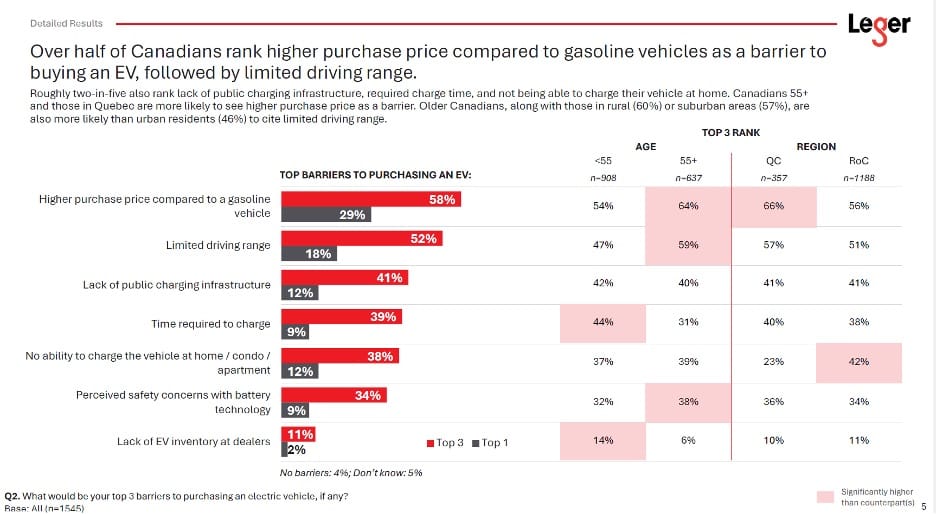
Other concerns included the time required to charge, the inability to charge at home, and worries about battery technology.
Notably, the availability of electric vehicles at dealerships was not a major concern. Only 11 per cent of respondents identified limited ZEV availability as a top barrier to adoption.