Growth follows pilot program that validated zero-emission delivery performance on set routes in Canadian conditions
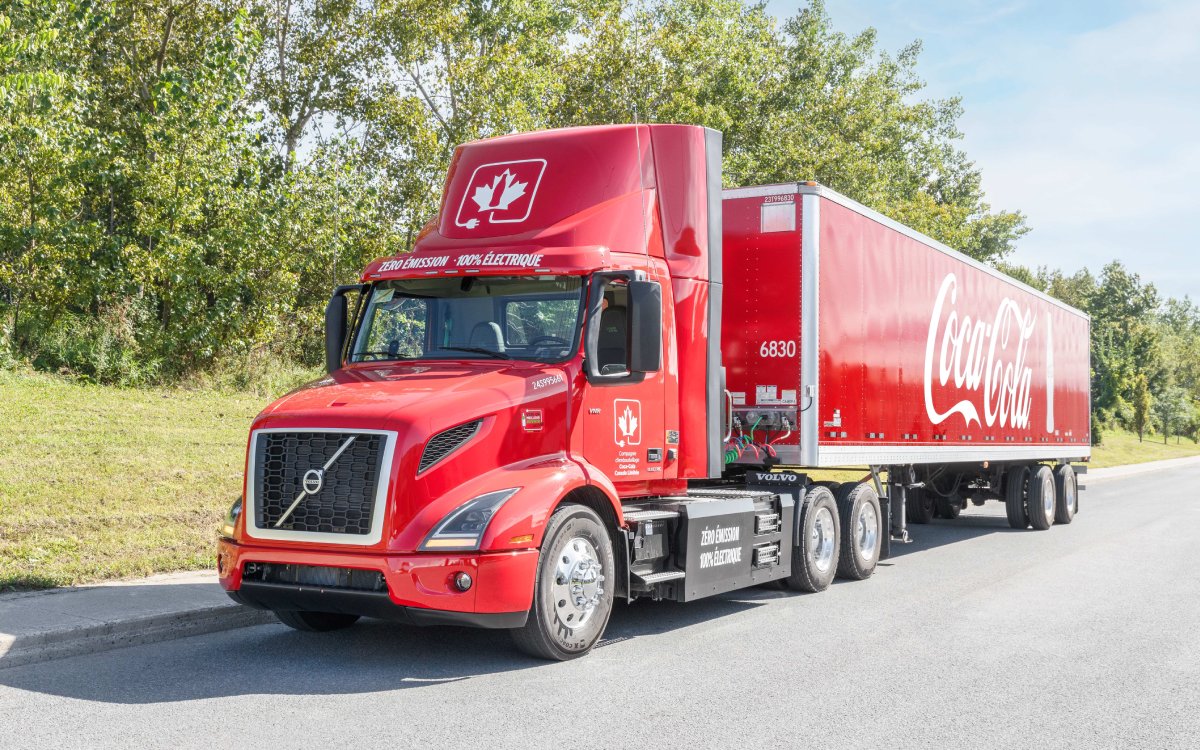
Coke Canada Bottling has added six new Class-8 electric trucks to its fleet. — Volvo Trucks
Growth follows pilot program that validated zero-emission delivery performance on set routes in Canadian conditions
Coca-Cola Canada Bottling is expanding its electric truck fleet following a successful pilot that put battery-electric Class 8 trucks into service on some of the coldest roads in Canada.
The company first introduced heavy-duty electric vehicles in 2023, selecting Class 8 Volvo Trucks after evaluating vendors based on capability and cost. Six Volvo VNR Electric trucks were initially deployed in the Montreal area.
Now, three new Volvo VNR Electric trucks are already in operation at Coca-Cola’s Quebec City facility. Later this spring, an electric yard truck will be added to the Montreal facility, with four additional new Volvos and two Class 8 Kenworth T880E trucks headed to the Vancouver operations.
‘Positive feedback’
“Through the addition of electric vehicles, our use of cleaner fuel options, as well as driving more efficient routes and vehicles, we’re able to lower emissions while continuing to service our customers,” said Darren White, vice-president of business strategy and sustainability for Coke Canada Bottling, in an email to Electric Autonomy Canada.
“We’ve received positive feedback from our drivers as it relates to their driving experience of our EV vehicles, and additionally, there are cost savings with fleet electrification, as the cost to charge is significantly lower than fuel costs.”
The expansion brings Coca-Cola Canada’s total electric vehicle fleet, including vans, trucks and yard tractors, to nearly 40 units nationwide.
Successful pilot project
Coca-Cola’s pilot, which began in 2023, focused on predictable local delivery routes of roughly 150-kilometre round trips from a central distribution facility.
The program was designed to assess performance across seasonal conditions, including winter operations and to evaluate how electric trucks could integrate into existing fleet logistics. It also supported the company’s broader efforts to reduce direct emissions, with support from federal and provincial incentives
“Starting with a pilot program allowed us to take a deliberate ‘test and learn’ approach, helping us to better understand operational considerations, infrastructure, and performance before scaling our electrification further,”said White.
“Since that initial pilot initiative, we’ve continued to explore innovative ways to reduce our carbon footprint through fleet electrification and the use of alternative fuel sources.”
The new trucks, say White, will continue to prioritize predictable local and regional routes, where range capabilities and route consistency support operational efficiency.
Don’t forget the charging
White says it is important for fleet operators looking to transition to electric vehicle to be aware of available incentives that can help offset the upfront costs of electric vehicles as well as charging infrastructure.
With an eye to the expansion, Coca-Cola Canada Bottling took advantage of the federal Incentives for Medium- and Heavy-Duty Zero-Emission Vehicles (iMHZEV) program for the trucks and is also working on provincial applications related to charging infrastructure funding.
Coca-Cola’s pilot electric trucks were supported by three on-site 150-kW DC fast-charging units. The company has installed one 180-kW charger in Quebec City and three more in Vancouver for the new trucks.
“Given the considerable upfront cost for both vehicles and charging, these programs can play a critical role in helping overcome the initial barriers to entry infrastructure,” said White.