Australian Class 8 truck conversion company Janus selects Mississauga-based battery manufacturer for its move into Canada and the U.S.
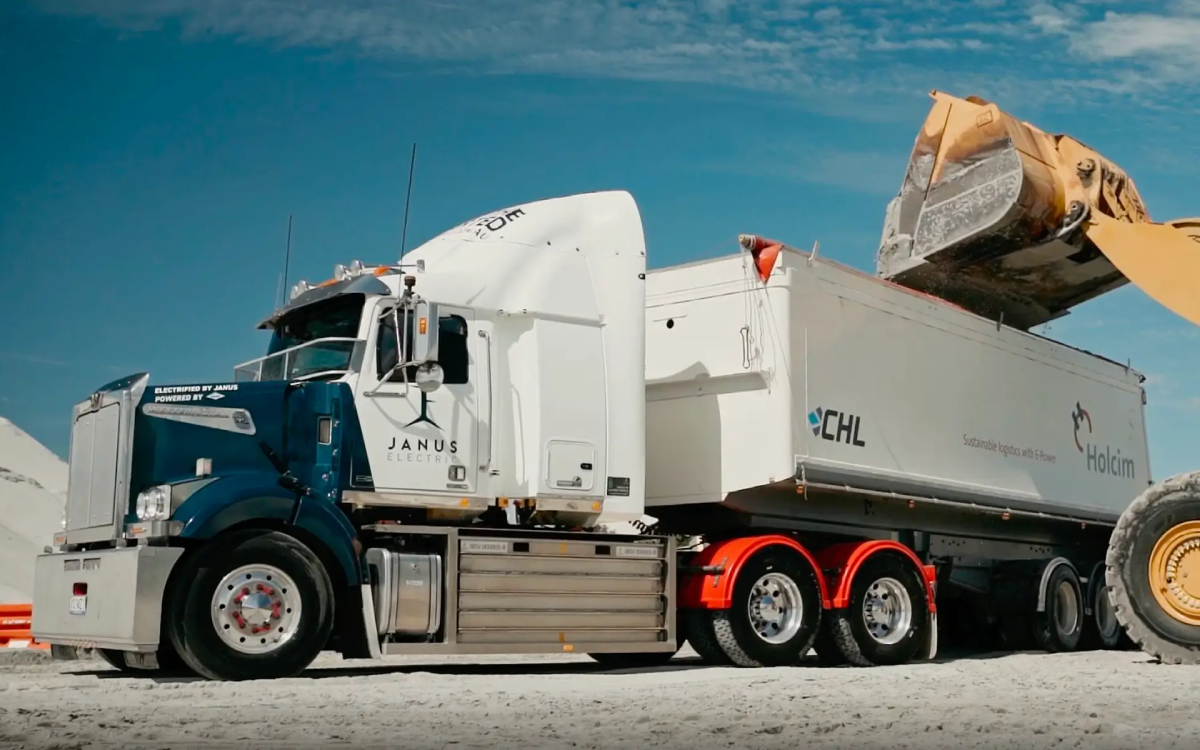
Janus Electric will use Electrovaya batteries in its move into Canada and the U.S. – Janus Electric
Australian Class 8 truck conversion company Janus selects Mississauga-based battery manufacturer for its move into Canada and the U.S.
Electrovaya Inc. will supply lithium-ion battery systems for heavy-duty electric trucks under a new strategic agreement with Australia’s Janus Electric, opening a new market for the Mississauga-based battery manufacturer.
The agreement, announced last week, comes with about US$26 million in initial purchase orders to meet demand for Janus products in the U.S. and Canada.
Janus converts diesel Class 8 trucks to battery-electric and powers them with swappable battery packs so fleets can exchange batteries in minutes rather than wait hours to recharge. Each conversion will use around 600 kilowatt-hours of Electrovaya batteries, split between two packs.
Electrovaya has also agreed to invest about US$1.4 million in Janus for up to 4.2 million shares, plus up to 6.3 million warrants.
A different solution
Janus has orders and commitments for 118 truck conversions in the U.S. and Canada.
“It’s a new vertical for the company,” Electrovaya CEO Dr. Raj Das Gupta said in an interview with Electric Autonomy. “Class 8 trucks are huge consumers of diesel, big emitters and have been a challenge to electrify.”
The big hurdles for electric trucks are range and charging time: batteries big enough to haul heavy loads take a long time to charge and fast charging them would require multi-megawatt chargers that just aren’t available.
Janus’s swap system sidesteps the problem.
The first shipments are going to California for drayage operations, where trucks haul containers on short, repeat routes between ports and nearby warehouses. That kind of predictable work is “the low-hanging fruit,” Das Gupta said, noting a single container ship can generate at least 2,000 truck trips.
The advantages of Infinity Battery Technology
Electrovaya uses something it calls, Infinity Battery Technology, which, the company claims, has three core advantages over other batteries, according to Das Gupta. The first is safety: conventional lithium-ion batteries use plastic separators between the positive and negative electrodes that can shrink when overheated, resulting in short circuits and fires. Electrovaya’s separators are more than 90 per cent ceramic by weight.
“That makes the material much more resilient for thermal exposure,” Das Gupta said.
The second is cycle life. Electrovaya’s batteries can do about 15,000 charge cycles before their capacities drop; a typical phone battery can do 1,000 cycles. That high number of cycles matters in a swapping model, where packs may be exchanged several times a day.
“That longevity really does play a role in a lower lifecycle cost,” he said.
The third is power density, which lets the batteries charge faster.
A ‘strategic’ investment
While the Electrovaya investment in Janus is relatively small, Das Gupta calls it “strategic.” Heavy-truck battery swapping has taken off in China, led by CATL, and Electrovaya wants to lead it in North America.
“If you look at their product and the cost structure, the batteries are the vast majority of the cost structure,” he said. “So already we’re somewhat intertwined at that level.”
U.S. production plans
The first Janus systems will be built at Electrovaya’s factory in Mississauga. Longer term, some will come from Electrovaya’s upcoming plant in Jamestown, N.Y., which will make cells, modules and packs and is expected to come online next year. Most of its output is expected to go to energy storage.
Das Gupta said Canada-U.S. political tensions have not affected the project. “We have both flags in front of the buildings” he said, adding that Electrovaya’s real competition is in Asia, especially China.
U.S. tax credits also make scaling production there attractive. “We’ve had a lot more support from the U.S. government than we’ve had from the Canadian side,” he added.
In 2027, Electrovaya expects to deliver batteries for more than 100 Janus vehicles, likely early in the year, with more demand to follow.
“I think it’s just the start,” Das Gupta said. “Trucking has been a difficult piece to electrify, and I think Electrovaya is the right company.”