Simard Westlink and four other trucking companies involved in pilot funded by provincial, federal governments
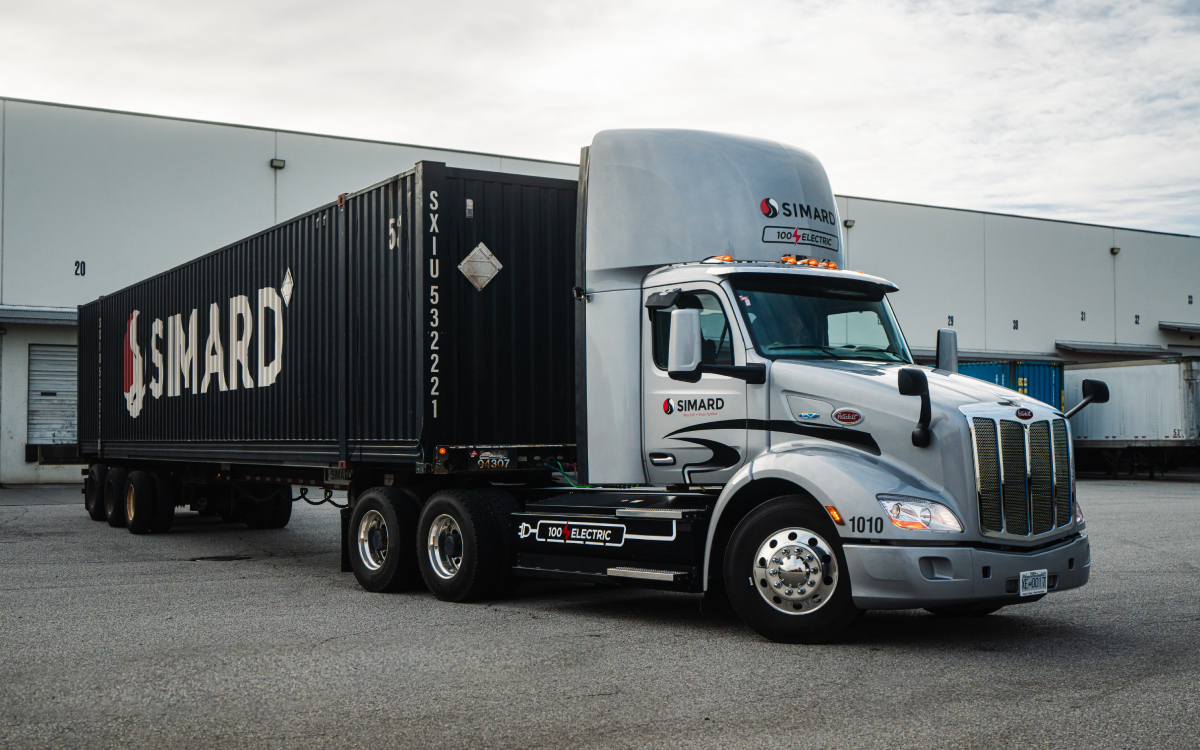
Simard Westlink uses two Peterbilt Model 579EV Class 8 trucks at the Port of Vancouver. — Simard Westlink
Simard Westlink and four other trucking companies involved in pilot funded by provincial, federal governments
The Port of Vancouver is running a pilot program that uses battery-electric trucks to take care of first- and last-mile container delivery.
The Electric Container Trucking Program (ELECTRA) offers five trucking companies subsidized five-year leases on Class 8 electric trucks and supporting charging infrastructure, along with maintenance, support and training. Data for all trucks will be recorded for the first year of the program and shared with both industry partners and government to inform future adoption of battery electric trucks.
Partnering on the program is 7Gen, a turnkey fleet electrification company based in Montreal and Vancouver.
‘Game changing’
Simard Westlink is one of the trucking companies involved in ELECTRA. It’s the regional division, based in Richmond, B.C., of Simard Transport, based in Montreal. The company is using two Peterbilt Model 579EV Class 8 trucks, each with a gross weight of up to 82,000 lbs and a range of up to 250 kilometres.
While the program officially started in May, Simard Westlink’s first truck began hauling in August last year. The second truck went operational in March.
Two trucks from other companies are also in use, with two more being added to the program later this year.
“The ELECTRA program has been game changing for our operations in Vancouver,” said Jason Hansen, director of operations for Simard, in an email. “It’s allowed us to be more open-minded to alternative power [and] the ability to use advanced technology and lower costs — all while having zero emissions.”
Lower operating costs
It’s not Simard’s first experience with electric vehicles. The company has been using eight heavy-duty trucks for inner-city operations at its facility in Montreal for two years.
“Electric trucks offer lower operating costs compared to diesel vehicles,” said Hansen. “They are more energy-efficient, converting 85-90 per cent of battery energy into motion, compared to 30-40 per cent for diesel trucks. This efficiency translates into significant savings over time.”
Electric trucks also eliminate greenhouse gas emissions, both from driving and from hours of idling, which is typical in a port environment. Hansen says it takes about 2.5 hours to charge each truck with its on-site DC fast charger.
Planning and education
Hansen said the initial challenges faced with the Vancouver project were load capacity and battery range, which were solved through planning and education.
“Our dispatchers are knowledgeable on the technology and dispatch these trucks accordingly,” he said. “We focus on lighter loads and shorter distances to maximize battery life.
“Our drivers also are knowledgeable and use regenerative braking, which adds between 10-15 per cent more charge, especially with our routes around town.”
‘From possible to practical’
Simard Westlink purchased both trucks through 7Gen, which also supplied data, training, best practices and other support.
“Drayage and medium-haul Class 8 are the segments where electrification has crossed the line from possible to practical,” said Frans Tjallingii, founder and CEO of 7Gen, in a press release.
“The trucks are operationally ready today, and the economics are getting more attractive every quarter.”
ELECTRA is part of the Low Emission Technology Initiative, a joint funding partnership between the Vancouver Fraser Port Authority and the Province of British Columbia.
The program garnered an estimated $3 million in combined support from Transport Canada, the Province of British Columbia and the Vancouver Fraser Port Authority. Additional funding will come from BC Hydro’s EV Fleet Program.
The four other trucking companies involved in ELECTRA are Aheer Transportation Ltd., Lally Bros. Holding Ltd., TransBC Freight Ltd., and West Coast Freight Ltd.