Peterbilt is expanding its battery-electric truck lineup, anchoring production at PACCAR Canada’s manufacturing facility in Quebec
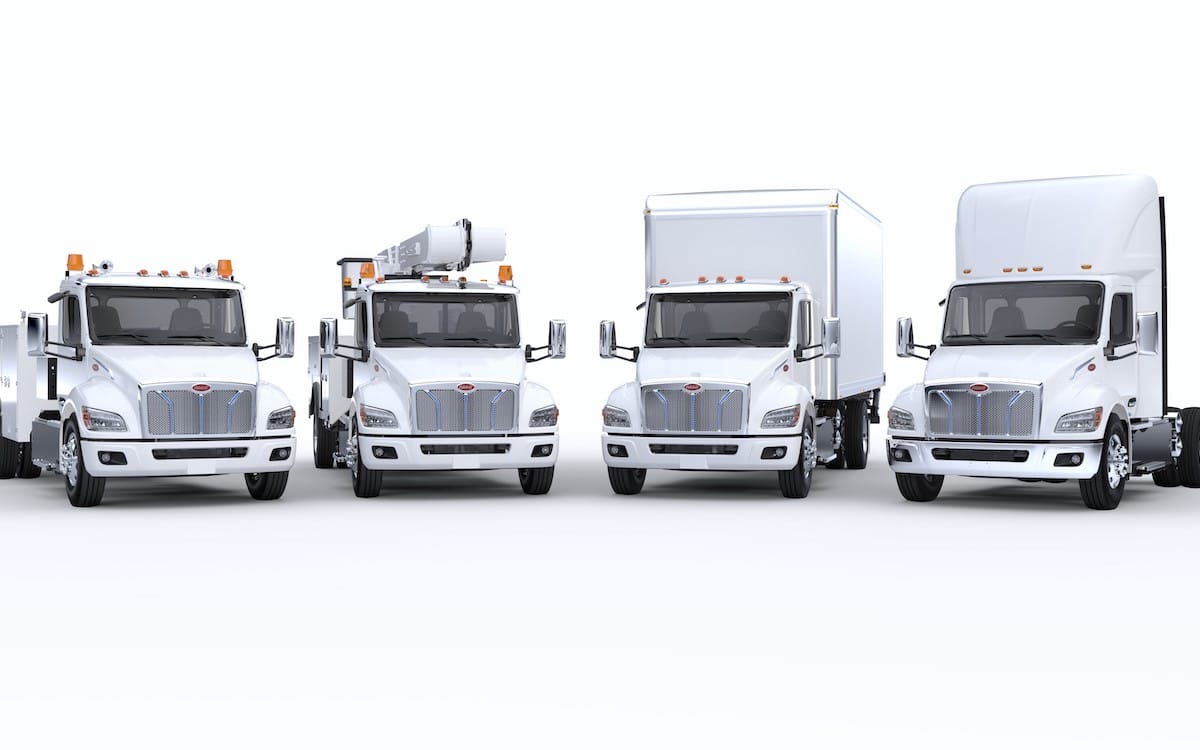
Earlier this month, Peterbilt expanded its battery-electric portfolio with three new models: the Class 6 536EV, the Class 7 537EV and the Class 8 548EV. Photo: Peterbilt
Peterbilt is expanding its battery-electric truck lineup, anchoring production at PACCAR Canada’s manufacturing facility in Quebec
A new line of medium-duty Peterbilt EVs will soon be hitting the roads across Canada and the United States, expanding the OEM’s growing portfolio in the medium- and heavy-duty segments.
Earlier this month, Peterbilt expanded its battery-electric portfolio with three new models: the Class 6 536EV, the Class 7 537EV and the Class 8 548EV.
The Class 6 536EV and the Class 7 537EV are designed to serve as regional delivery, service and utility trucks. The 548EV is a Class 8 configuration set up for use as a 4×2 tractor, or as a vocational vehicle, such as a dump truck, that requires a power take-off (PTO) capability.
The trucks will be assembled at Peterbilt’s parent company, PACCAR Canada’s manufacturing facility in Ste-Thérèse, Que., according to Martin Blanchet, Peterbilt Canada’s national sales manager, alternative powertrain, in a post on social media.
“Great news for Quebec and Canadian markets: these vehicles will be assembled locally at the PACCAR Canada plant in Quebec, driving innovation in manufacturing and creating sustainable jobs right here at home,” he said. “Peterbilt is proud to lead the way toward a greener future for heavy-duty transportation.”
While some of the production output will remain in Canada, the majority of trucks built at the Quebec plant will be exported to the U.S. market, reflecting continued cross-border demand for medium- and heavy-duty zero-emissions vehicles.
Powertrains and charging capabilities
The new models are built around PACCAR’s existing ePowertrain platform, which already powers the Peterbilt 579EV and 567EV models.
The PACCAR ePowertrain’s dual electric lithium iron phosphate battery-based (LFP) motors are midship-mounted and are mated to an integrated three-speed transmission. The platform allows for a variety of configurations, with the most powerful option resulting in 605 horsepower and 1,850 lb.-ft. of torque. All three models are capable of reaching an 80 per cent charge after about 80 minutes of fast-charging.
PACCAR offers both AC and DC charging solutions, with DC fast-charging capacity of up to 400 kW. Charging infrastructure planning and installation is delivered through partners QMerit and Schneider Electric, providing end-to-end support for fleet deployments.
Model specs
Individually, each model’s specifications are as follows:
- The 536EV delivers a maximum of 470 hp and 1,100 lb.-ft. of torque. It runs on 250 kWh batteries, resulting in a range of up to 200 miles (322 kilometres). The EV is compatible with wheelbases of 163 inches or longer and has a 25 kW electric power takeoff(ePTO) provision.
- The 537EV has 605 hp and 1,850 lb.-ft. of torque. This model offers two high-voltage battery options — 250kWh and 375kWh — with a range of up to 280 miles (451 km). It also has 25 kW and 150 kW ePTO provisions and a wheelbase that can accommodate 163 inches or longer, with factory-installed lift axles available.
- The 548EV’s battery configurations range from 250kWh to 375kWh, resulting in up to 605 horsepower and 1,850 lb.-ft. of torque, with a range of up to 200 miles (322 km). The trucks offer the choice of 25 or 150 kW ePTO provisions. This model is also designed for wheelbases of 163 inches or longer, with factory-installed lift axles available.