BEVs lead the segment at 7.4 per cent while PHEV share plateaus as overall vehicle registrations decline
BEVs lead the segment at 7.4 per cent while PHEV share plateaus as overall vehicle registrations decline
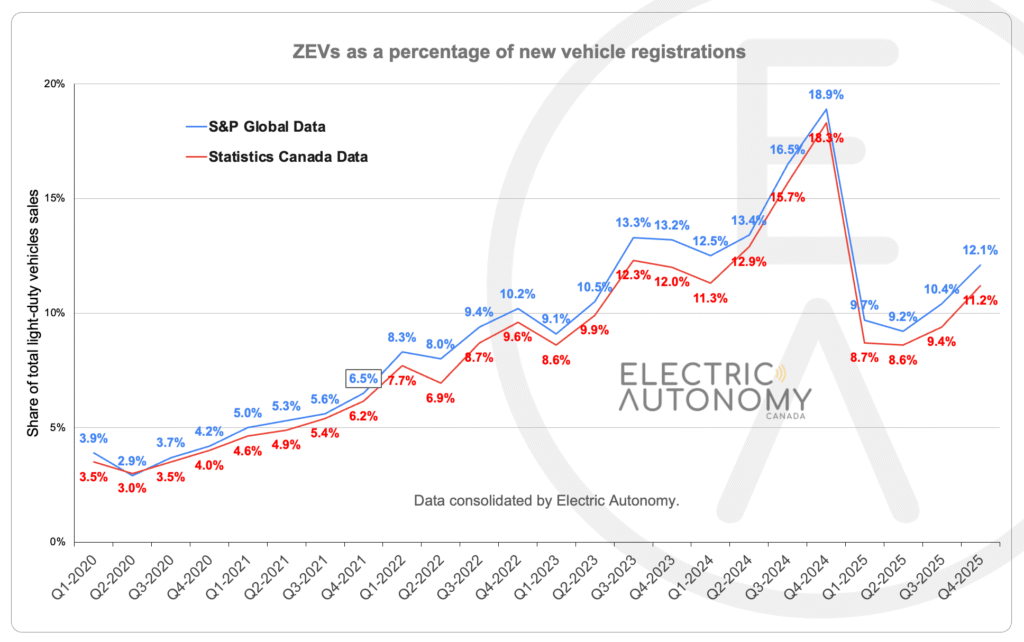
New ZEV registrations across Canada hit 11.2 per cent market share in Q4 2025, according to the latest data from Statistics Canada.
While that is an increase over the 9.7 per cent market share of ZEVs from Q3 2025, it represents a drop in overall volume.
Total registrations of ZEVs from Q3 was 47,222 out of 486,283 total registrations in Canada. In Q4, 46,170 ZEV units were sold out of 411,663 total new vehicles registered.
Battery electric vehicles (BEVs) made up the rise for the ZEV segment, with an increase in market share from 5.9 per cent in Q3 to 7.4 per cent in the last quarter. Significantly, registrations also rose, from 28,648 registrations in Q3 to 30,464 in Q4.
PHEV market share plateaus
Meanwhile, plug-in hybrid electric vehicles (PHEVs) had a drop in sales numbers quarter over quarter, from 18,574 in Q3 down to 15,706 in Q4. Due to the drop in overall sales during that period, however, market share remained at 3.8 per cent.
(Note: StatsCan classifies BEVs and PHEVs as “zero-emission vehicles.” This grouping does not reflect Electric Autonomy’s policy, which considers only non-combustion engine vehicles as zero-emission. However, where statistics refer to ZEVs, we have adhered to StatsCan’s definition for consistency.)
Provincial sales down
ZEV market share increased across some provinces, but this is largely due to the lower overall number of new vehicles registrations.
For example, Quebec ZEV market share rose from Q3’s 18.5 per cent up to 19.2 per cent in Q4, despite a drop in registrations from 22,729 units in Q3 to 20,461 in Q4.
Ontario also saw an increase in ZEV market share, from 6.4 per cent in Q3 up to 7.3 in the last quarter. That’s despite another drop in ZEV sales, from 11,890 units in Q3 to 11,261.
Of the provinces, only British Columbia experienced a rise in both market share and sales, with ZEVs making up 20.8 in Q4 compared with 15.6 in Q3. Registrations rose to 9,997 from 8,256.
Two of the three territories also saw ZEV registrations rise, albeit slightly. Yukon’s total ZEV registrations went from 22 in Q3 to 26 in Q4, while Nunavut went up to a single ZEV registration in Q4.
Year-over-year decline
Over the course of 2025, ZEV registrations dropped by 44.7 per cent compared with the previous year.
By the end of 2025, ZEV registrations made up 9.5 per cent of all vehicle registrations — down from 14.6 per cent by the end of 2024.
The last quarter of 2025 saw the largest decrease year over year: down 43.2 per cent from Q4 2024.
That drop between 2025 and 2024 can be attributed to the spike in ZEV registrations in the last part of 2024 as Canadians anticipated the end of the Incentives for Zero-Emission Vehicles program and rushed to purchase a ZEV.
A new incentive program, the Electric Vehicle Affordability Program (EVAP), went live this month, offering $5,000 for a BEV and $2,500 for a PHEV for purchases as far back as February 16.
Editor’s note: Q3 sales data has been updated by StatsCan since publication in December.