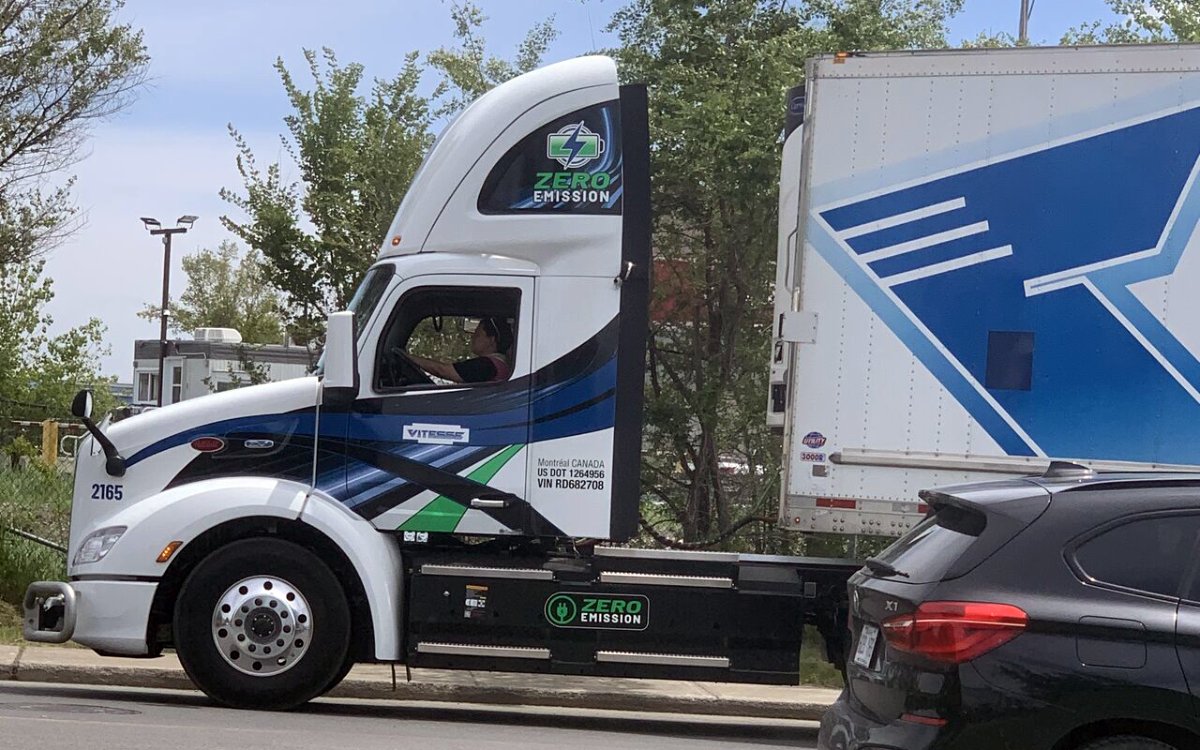
A Montreal trucking company that hauls temperature-sensitive pharmaceuticals across North America says the two electric trucks in its fleet are proving their worth, even if they are not yet ready to replace diesel on the long-haul runs that make up most of its business.
Vitesse Transport operates 32 heavy-duty trucks running local, regional and cross-border routes, with Canadian operations in Quebec, Ontario, New Brunswick, Nova Scotia and Newfoundland and Labrador, and lanes extending into the United States and Mexico.
Vitesse put its first two battery-electric Class 8 tractors into service in 2024. They make up about 6.2 per cent of the fleet.
The company says the electric trucks are not set aside for showcase work but run in full rotation alongside the diesel tractors on shorter hauls.
“They pull whatever the job requires, same as any diesel tractor in the fleet,” a company spokesperson said.
But the company is upfront about the limits. Its electric trucks average about 51 kilometres a day, compared with roughly 530 kilometres a day for each of its diesel trucks.
“That’s not a shortfall we’re hiding – it’s the honest limit of current EV range and charging infrastructure for a cross-border cold-chain operation,” the company said.
Long-haul and cross-border lanes will stay diesel, Vitesse said, until the technology and the charging network can handle them without putting temperature compliance or delivery reliability at risk.
“Range and infrastructure aren’t there yet for the work that makes up most of our business, so we matched the vehicles to the routes they can actually do reliably, rather than forcing electrification where it doesn’t work and calling it a win,” the company said.
In 2025, the two electric trucks covered 18,407 kilometres with freight, according to the company, which drew its figures from fuel tax filings.
Vitesse estimates those electric kilometres displaced about 7,270 litres of diesel, worth roughly $14,900 at current Quebec fuel prices, and avoided about 19.6 tonnes of carbon dioxide emissions from combustion.
Because the trucks charge on Hydro-Quebec’s largely hydroelectric grid, the company says only a small share of those savings is offset by emissions from electricity generation, leaving a net reduction in the high teens of tonnes.
The trucks are charged overnight at the company’s single charging depot, which uses DC fast chargers, with at least one charging port for each electric truck. Vitesse does not share its chargers with other fleets and says it is planning, but has not yet adopted, smart charging or energy management systems.
The company bought the trucks outright and said it received a government incentive through the dealer, though it did not specify which program.
The company said it did not wait for a regulatory mandate or customer demand before adding electric trucks, and argues its approach – testing the vehicles on regulated, real-world freight within their limits – is more meaningful than a showcase pilot.
“We put real trucks on real routes and started counting honestly,” the company said. “That’s a result we’d put up against fleets many times our size.”
Sponsors & Partners