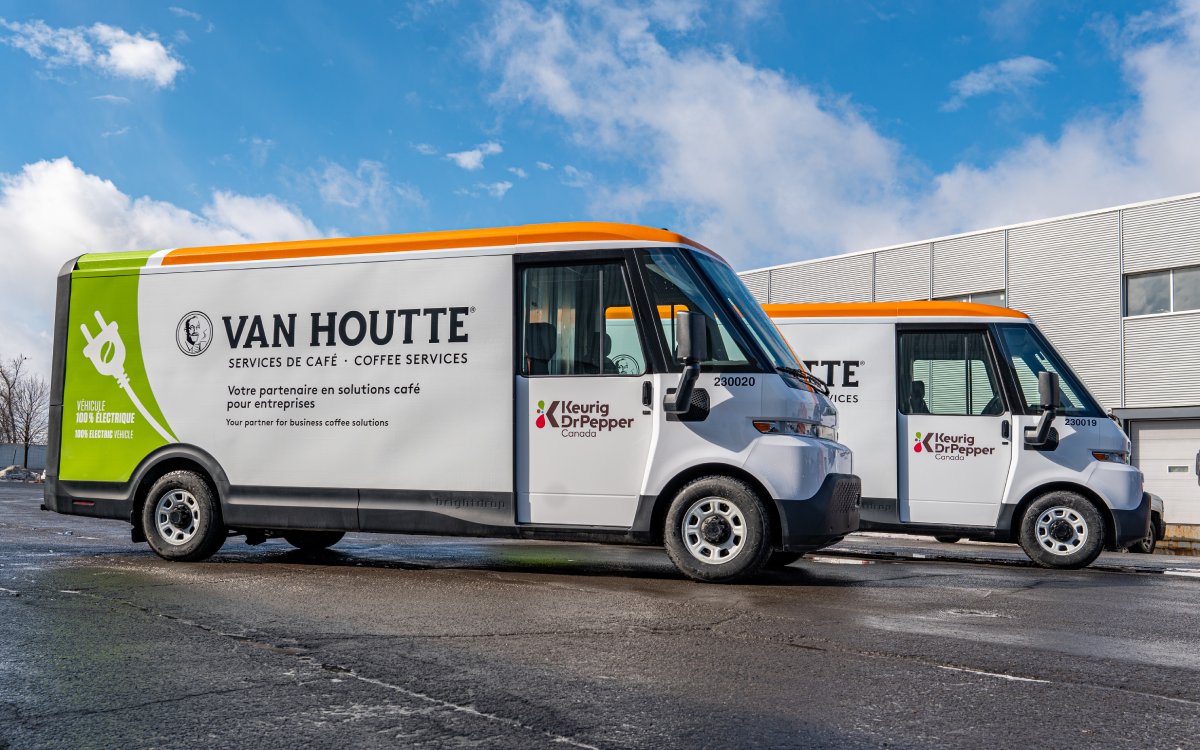
Van Houtte Coffee Services’ fleet electrification didn’t start with a plan. It started with a phone call from a dealer.
“He said, ‘I have my very first Ford E-Transit. What do you think?’ And we just jumped on the occasion,” said Kevin Rouleau-Thiboutot, director of fleet operations for the coffee distributor.
That electric van arrived at the end of 2022. The company bought 18 more the next year, and what began as an opportunistic purchase quickly became a strategy.
Today, about 70 of Van Houtte’s 240 delivery trucks are electric, more than 29 per cent of a fleet that serves customers from Atlantic Canada to British Columbia.
Rouleau-Thiboutot, who has been with the organization for more than 20 years, took charge of the national fleet in 2021. He said customers began asking whether the company could offer electric service.
“We quickly realized the impact of having [electric vehicles] has on the image of our company.”
The savings soon followed. Fleet-wide fuel spending fell 10 per cent in 2023 compared with the year before. That’s when Rouleau-Thiboutot began planning an electrification strategy.
The company focused first on its largest centres in Montreal, Toronto and Vancouver, with an emphasis on Quebec and B.C., which offered MHDV rebates. About 70 per cent of its trucks return to a depot every evening, giving them roughly 12 hours to charge on Level 2 chargers.
But growth outpaced planning.
“Every decision we took, it just went faster than what we thought,” Rouleau-Thiboutot said. “It was not long before we needed to install seven, eight, 10 chargers at a single location, and that was not really planned when we installed the first charger.”
The Montreal depot now has 17 Level 2 chargers, and last year the company added a DC fast charger. It serves as a backup in case something goes wrong with evening charging, and gives those drivers who keep their trucks at home a place to top up when they stop by the office.
The biggest hurdle, though, was winning over the people behind the wheel.
“For some drivers, it was not an option for them. ‘No, you need to give me a gas truck,’” Rouleau-Thiboutot said.
Winter, often seen as a weakness for EVs, helped change their minds. Because the trucks are plugged in overnight, they can be preconditioned, so drivers arrive on cold, snowy mornings to warm cabs and clear windshields.
Rouleau-Thiboutot began formal EV training for his drivers. The company also carefully planned deployment and routes so drivers could finish a day on a single charge.
“Since the beginning, we tried really hard to keep this journey positive,” he said. “We are not trying to put our drivers in an uncomfortable position.”
Now the company has hit a different wall: vehicle availability. While the E-Transit is suitable for many of Van Houtte’s daily routes, its limited range (just over 250 km) makes it unsuitable for longer routes. Rouleau-Thiboutot says a lack of alternative vehicles with longer range has kept the company from adding more EVs to the fleet this year.
Instead, Van Houtte Coffee Services is focused on getting more out of the vans it already has. EVs make up 29.2 per cent of the fleet but account for only 17 per cent of kilometres travelled. The goal is to move them onto more valuable routes and push that share past 20 per cent.
When asked to give advice to other companies thinking of electrifying, Rouleau-Thiboutot is adamant: build carbon credits into any electrification plan. Van Houtte’s electric trucks travelled just under one million kilometres last year, and the credits they generated worked out to about 20 cents per kilometre.
“That’s really a game changer,” he said. “Not all fleets generate those credits, so just know that it’s something that is accessible.”
Sponsors & Partners