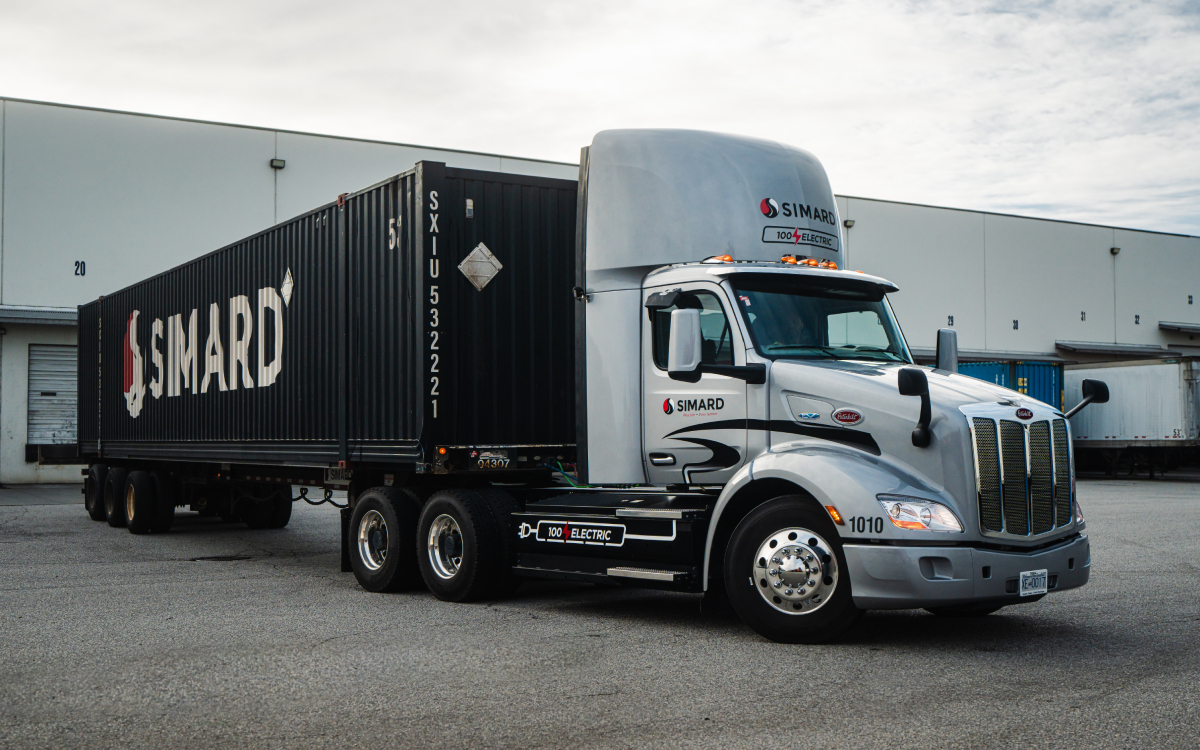
Simard Transport, a Montreal-area trucking and logistics company, has been operating since 1943. It provides transportation, warehousing and logistics services, with facilities near ports, airports and rail yards in Montreal, Toronto and Vancouver.
Today, the company runs 12 battery-electric heavy trucks, just over three years since getting its first four Freightliner eCascadia trucks on the road in Quebec in 2023.
“We were seeing a trend in our customers who wanted to reduce their emissions and be more environmentally friendly,” said Brandon Abraham, the company’s vice-president of corporate services. “So we wanted to make sure we’re ready to have those conversations and to have that equipment available for them.”
Cleo, a Hydro-Québec subsidiary, installed Simard’s first chargers in 2023, at Simard’s Lachine site: two 120-kilowatt fast chargers and two 24-kilowatt redundancy units. The trucks run during the day and charge overnight.
The Montreal fleet now also includes four new Kenworth trucks and two Volvos. Four of the Montreal trucks are dedicated to a single, longtime customer, moving goods between warehouses all day. The rest haul local van loads and containers from the Port of Montreal.
Two more trucks, Peterbilt 579EVs, are working on the West Coast, hauling containers between the port and customers. Simard is one of five trucking companies in the Electric Container Trucking Program, known as ELECTRA, at the Port of Vancouver. The pilot, backed by an estimated $3 million from Transport Canada, the B.C. government and the Vancouver Fraser Port Authority, offers subsidized five-year leases on electric trucks, along with charging equipment, training and maintenance support.
Abraham said the trucks come close to breaking even with diesel, thanks to subsidies and good pricing. Then came a nice surprise with the carbon credits, valued at almost $400 each in 2026.
“I wish my whole fleet could run with electric trucks,” he said.
Battery health has also held up better than expected, dropping about five per cent at first and roughly two per cent a year since.
Abraham said Simard’s relatively high-volume, shorter routes are ideal for today’s electric trucks, which have ranges of around 250-300 km. But the company plans to explore other options with two hydrogen fuel cell trucks next year.
“We realize that it’s not just one solution that’s going to win,” he said. “Hopefully, obviously, the zero-emissions solutions will probably win out in the end. But it’s not going to be only electric trucks.”
With a variety of trucks across the country, Simard Transport has learned what works and what doesn’t when it comes to electrifying fleets. Abraham says the biggest step is knowing what fits for each fleet’s purpose.
“The first thing they need to do is understand the limitations of today’s electric trucks with regards to mileage, payload and charge time,” said Abraham. “Then look within the applications of their fleet and find where it makes sense to implement this technology. And then try it!
“Follow the trucks closely. Don’t just throw it into the fleet. You need to learn what works well, and what it might struggle with. Only then will you be able to make better decisions on where this technology fits within your business.”
Simard has more than 500 trucks. Last year it set a target of electrifying 12 per cent of its company-operated fleet by 2030, or about 30 trucks. Longer term, Simard wishes to power up a Montreal terminal with a lot more room for chargers.
“Hopefully that’ll give us a lot more room to increase our electric fleet,” said Abraham. “With the applications we have, I could have half my fleet on electric trucks.”
Sponsors & Partners