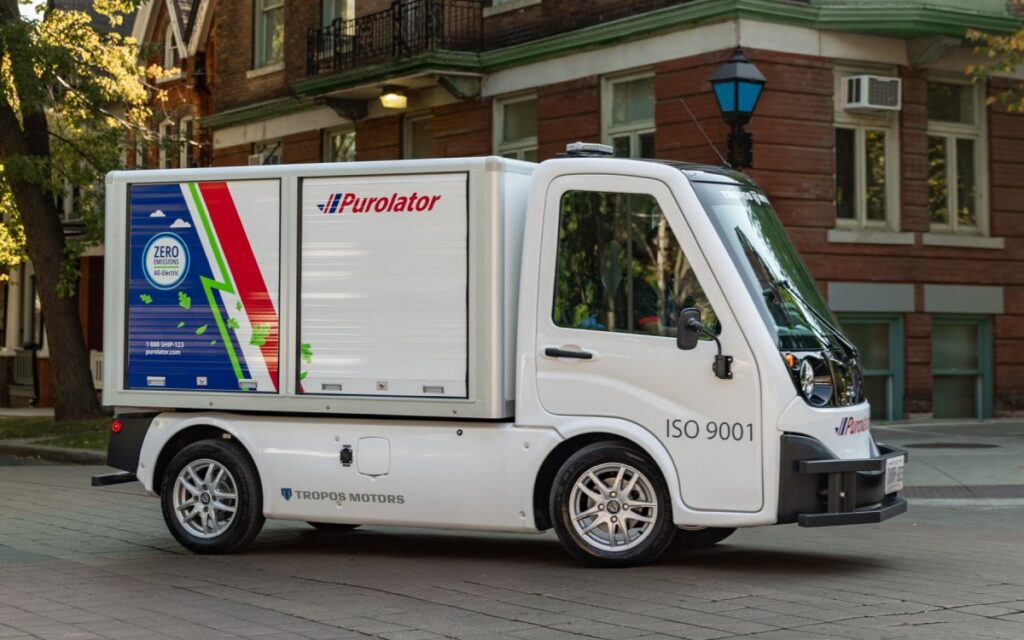
Purolator Inc. is on track to have about 900 electric delivery vehicles on Canadian roads by the end of the year, a sharp climb from just over half that number a year ago, as the courier company pushes its electrification program from coast to coast.
The electric vehicles are all used for last-mile delivery, said Cindy Bailey, the company’s vice-president and corporate sustainability officer.
Purolator tested five electric vehicles before launching a larger pilot at three locations in 2022. Now it has 566 battery-electric vehicles and 17 electrified terminals. This year, it is adding nine more terminals for a total of 26.
A change of priorities
The pace reflects a change in motivation. The program began as part of a decarbonization plan aimed at net zero by 2050, but a dramatic reduction in operational expenses has since become an equal priority.
“We’re continuing to be focused on our goals, which include being the greenest carrier in Canada. And I feel very confident we are,” said Bailey.
“The big part that’s also come into play in the last year has been around operational efficiency and cost savings and return on investment – total cost of ownership. So, a real sort of shift at a leadership level to take both of these things equally into consideration.”
Proof is in the data
The numbers have begun to support that. She said the vehicles save money on fuel and maintenance, estimating maintenance costs at roughly 30 per cent lower.
The company’s depreciation cycle for the electric trucks is 12 years, but Bailey said they now cover their initial cost in eight to nine years and are expected to stay on the road for about 15.
“When we started, we weren’t necessarily showing a positive total cost of ownership, but now these vehicles are paying for themselves,” she said.
All charging takes place at Purolator terminals, using Level 2 and Level 3 chargers. The faster Level 3 units serve as emergency backup and will support larger vehicles as the fleet grows. Purolator is adding three- and five-tonne trucks and expects to bring in Class 8 tractors within one to two years.
Longterm planning
The rollout has had hurdles. Bailey said the company underestimated how long utility power upgrades and equipment deliveries would take.
“We did run into a few instances where you have a vehicle show up and you don’t have the charging infrastructure, and that’s a really big problem,” she said.
Purolator now plans infrastructure 18 months to two years ahead.
Another lesson was the importance of training and change management for staff. “At first, a lot of people are like, ‘You’re just going from an ICE vehicle to an EV. It’s not that big a deal.’ But in truth, it is a big deal,” she said.
“So we’ve invested in the program in terms of having a really robust governance, and a program around training and change management and communications.”
Communication is key
Educating people on electric vehicles doesn’t stop with the drivers. Bailey says that part of her job now involves communicating the benefits and reasoning behind fleet electrification – both inside and outside the company.
“Storytelling has been a really big thing that we’ve had to learn,” she says. “So critical in terms of how we tell this story to the leadership, to the board, to get everyone’s buy-in, to understand the reasons behind the change.
“And industry collaboration has been really key, because when it comes to policy and a lot of the potential roadblocks that we’re facing in Canada, we really need to work together as an industry on this.”
Looking further out, Purolator wants its last-mile fleet to be close to 100 per cent electric by 2035. Heavy-duty trucks are a tougher challenge. Bailey said Class 8 electric trucks are expensive, charging infrastructure across Canada is limited, and government incentives have faded.
“The nut we need to crack, or what we need to unlock now, is really around the heavy-duty vehicles,” she said.
Sponsors & Partners