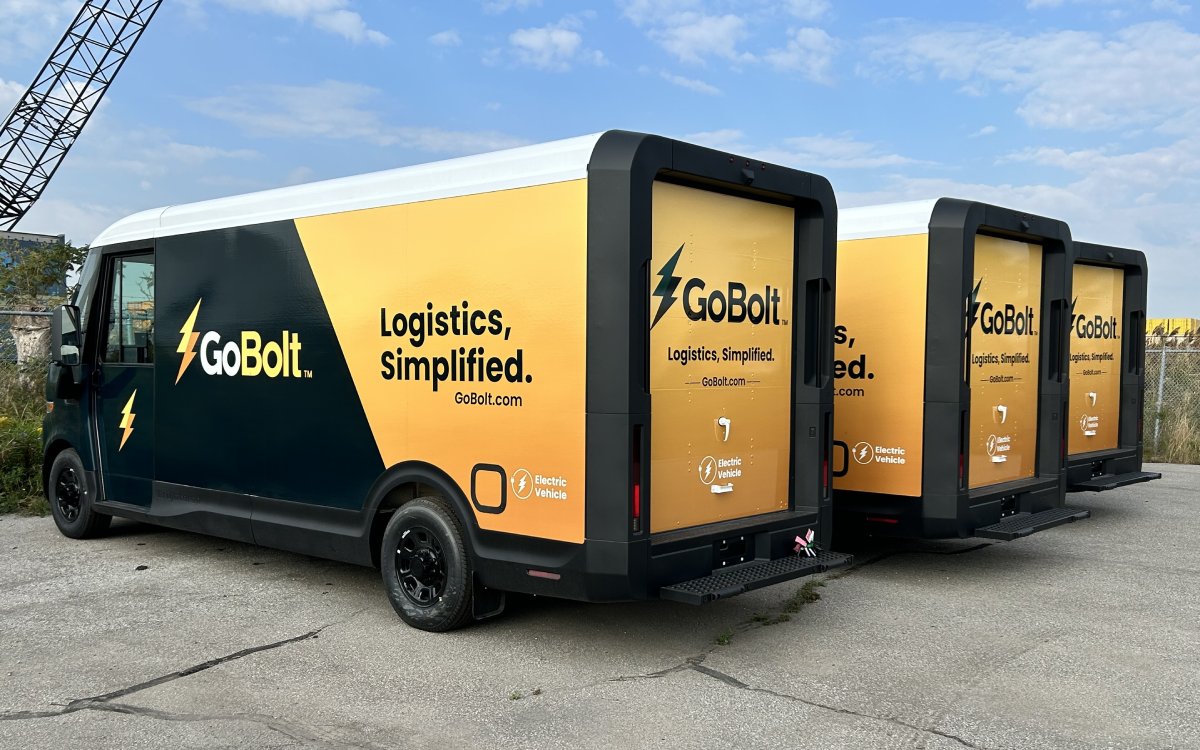
When Mark Ang looked at how quickly his delivery company was growing, he saw a fuel bill that was only going to get bigger.
So GoBolt, the Toronto-based logistics company he co-founded, chose to build its fleet around electric vehicles instead.
“As we scaled our business, we were going to be spending an inordinate amount of money on diesel,” said Ang, GoBolt’s co-founder and CEO.
“Can we challenge ourselves to think about it differently and build with a primary focus on electric fleets?”
Ang and Heindrik Bernabe started the company in 2017 as a storage service for university students. It has since grown into a logistics provider that handles warehousing, order packing, shipping and last-mile delivery for retailers.
The company put its first electric trucks on the road in 2019. It now runs a large and growing electric fleet across Canada, ranging from passenger vehicles to light- and medium-duty vans and medium- and heavy-duty Class 6-7 trucks. The largest deployments are in Montreal, Toronto, Ottawa and Vancouver.
In 2025 alone, those vehicles completed 2 million all-electric deliveries, helping avoid more than 2,000 tonnes of greenhouse gas emissions.
Charging investment
From its first EVs, GoBolt made a significant upfront investment in its own depot charging, tailored to each site, rather than relying on public infrastructure.
“Public infrastructure was not what it is today,” Ang said.
At a narrow lot in Richmond, B.C., for example, which Ang compared to a sliding-block puzzle game, the company installed sequential chargers. Each of the three units links five chargers together but powers only one truck at a time, which meant working through software and vehicle compatibility problems.
At depots with more room, chargers are simply lined up along warehouse doors or a row of parking spaces. Ang said the benefits of electrification go beyond zero tailpipe emissions.
Drivers get a smoother ride and feel better about the job, he said, and the company built its own carbon calculator, aligned with the Science Based Targets initiative, to measure the emissions it avoids.
“I’d say that there’s a societal customer and team benefit and lift,” he adds. “Everyone feels better about what we’re doing.”
The financial benefits
There are financial benefits too, he said, especially this year as global conflicts have pushed up diesel prices.
“We look pretty smart having an EV fleet, and our clients are benefiting because they’re avoiding fuel surcharges,” Ang said.
The road to electrification for GoBolt has not been easy, and Ang acknowledges it would be the same for any company. But he says anyone can succeed if they know and manage every aspect of the switch.
Fleets need a large amount of money up front before seeing any savings, he says, and the return on that investment is not guaranteed. Installing chargers can require landlord co-operation, agreements to restore the property, and deals among landlords, lenders and financiers.
Then come driver training, route planning and technology changes. “You need six out of six happening to realize the outcome,” he said.
His advice for fleets that have not yet made the switch is to be wary of thinking there is some easy, plug and play approach. It’s more important for smaller fleets, Ang says, to get a handle on the technology first-hand. “Start in control so you can truly understand the levers of this,” Ang said. “It’s really phenomenal when you can get it to work, and you do not need to go big.
“You can just start with one truck.”
Sponsors & Partners