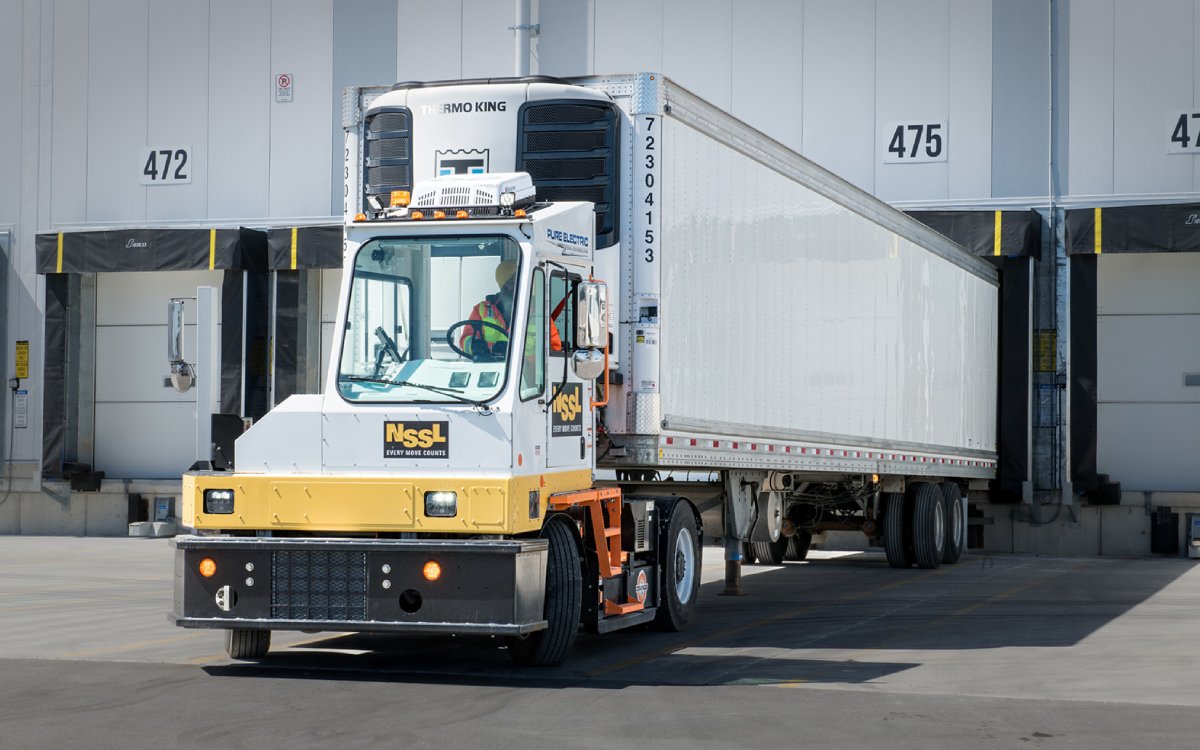
The trucks that shuffle trailers around Canadian distribution yards are getting quieter.
National Shunt Service Ltd. (NSSL), a Toronto-area company that runs trailer-moving operations at its customers’ warehouses, distribution centres and factories, now has 42 electric shunt trucks working at sites in Canada, up from 27 at the end of June.
After starting with one electric truck in 2024, the company expects to have close to 50 by the end of the first quarter of 2027, said Darren Fitzgerald, its chief commercial officer.
“It’s part of every customer conversation we’re having today. If customers aren’t asking about electrification, we’re bringing it to the conversation.”
Assessing each facility
Shunt trucks, also called yard trucks, are short-haul tractors that move trailers between loading docks and parking spots within a single site. NSSL supplies the whole package – trucks, drivers, field supervisors, fuel or electricity and maintenance. It operates in Canada and the U.S.
Its trucks and staff are stationed at the customer’s facility, which Fitzgerald said shaped how it approached electric vehicles.
“We don’t control the facilities,” he said, noting each site has to be assessed and fitted with chargers before electric trucks can go in.
For fleets weighing a switch to electric, Fitzgerald recommends a pilot program – basically what NSSL does with every new customer using electric trucks. It brings a couple vehicles to a site and studies the data over a period of time, such as two weeks: battery charge on the busiest day, trailer weights, terrain, temperatures and operating hours.
Data to plan ahead
Geotab telematics devices track pertinent data of each vehicle, giving what Fitzgerald describes as an essential overview of the entire fleet to compare efficiencies and cost, as well as the ability to plan ahead.
“The data allows us to identify potential maintenance issues before they result in an outage. Just as importantly, it gives us the analytics to understand idle time, fuel and energy consumption, utilization and overall operating efficiency.”
Fitzgerald said cost compared with diesel trucks decides whether a customer makes the switch. The telematics help demonstrate the business case for electric vehicles.
Government incentives helped early on, though most are no longer available outside a couple of provinces, he said. High diesel prices have strengthened the business case.
“Sharing real data and facts, working through the operational realities, and bringing our customers along on the journey have all been huge drivers of successful adoption.”
Drivers embracing EVs
Electric trucks now work at about four sites in Quebec, 11 in Ontario and one in British Columbia, and the company is pursuing an opportunity in Alberta. Most come from Kansas-based manufacturer Orange EV, though NSSL also uses a second supplier.
Drivers have embraced the trucks, which are smoother and quieter than diesel models, Fitzgerald said. At sites running both kinds, drivers tend to gravitate towards the electric trucks, so much so that the company is studying whether staff turnover is lower where they are used.
Maintenance costs are lower and uptime has been better than the diesel fleet, he said, though he noted the electric units are still relatively new. Cold weather does take a toll on range, he said, but choosing the right specification for the climate has produced promising results so far.
Fitzgerald said shunting is well suited to battery power because the trucks never leave the yard and stay close to their chargers.
“Yard operations are uniquely suited to electrification. The vehicles operate in a defined environment, return to the same location and remain close to charging infrastructure. Over time, I believe electric will become the default for many of these applications,” he said.
Sponsors & Partners