Program aims to help small- to medium-sized enterprises accelerate growth in the EV supply chain
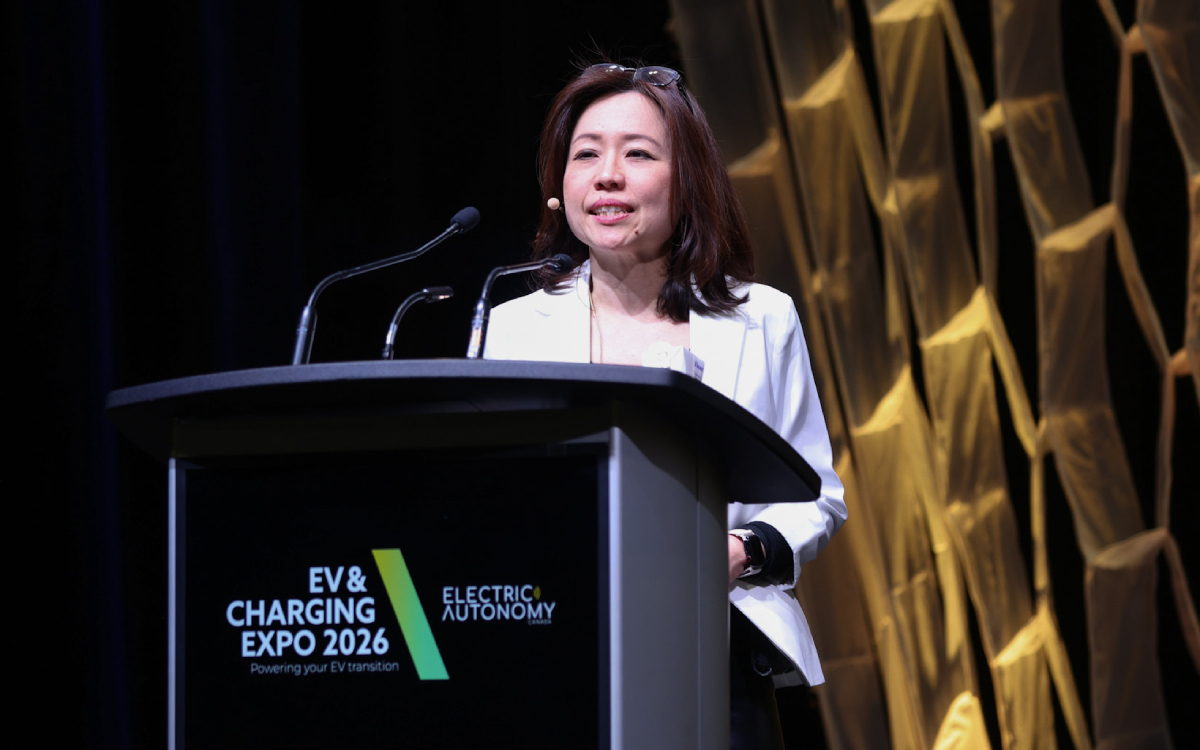
Sooky Winkler, director of NRC’s e-Auto Challenge program, at the EV & Charging Expo 2026. — Shane Parent, Electric Autonomy Canada
Program aims to help small- to medium-sized enterprises accelerate growth in the EV supply chain
Today at the EV & Charging Expo 2026 the National Research Council’s (NRC’s) e-Auto Challenge Program announced its first call for applications will open on April 15.
The program, which soft-launched in November last year, is aimed at providing funding for small- to medium-sized enterprises (SMEs) to stimulate and support innovation in the electric vehicle (EV) supply chain.
The announcement was made by the program director, Sooky Winkler. An online information session is also planned for April 14 and 15.
Practical solutions
The e-Auto program is scheduled to run until 2033. To stimulate innovation in electric vehicles, the program focuses on four main areas that have the greatest potential for major impact on the EV supply chain:
- Advanced power electronics;
- Next-generation electric motors;
- Optimized battery systems; and
- Enabling technologies (such as connected autonomous vehicle (CAV) technologies, vehicle cybersecurity and post-quantum communication, smart charging and grid load management for improved safety, security and energy efficiency)
In an interview with Electric Autonomy Canada, Winkler says the e-Auto Challenge differs from other programs with the NRC in that it is looking for real-world, practical solutions that will immediately benefit the supply chain.
“e-Auto is industry focused. The bulk and majority of funding goes to industry,” she said.
“This is worth emphasizing, because there are other Challenge programs the NRC has and the vast majority … are focused on fundamental research. Most of their funding goes to academia.”
‘Commercialization pathway’
Eligible SMEs to the e-Auto program range from industry, academic, government, community partners, not-for-profits, Indigenous governments and organizations and other stakeholders.
Winkler emphasizes that successful applicants must have a plan to move forward into the production space.
“These are usually multi-partner projects, because multi-partner means we have a technology receptor or potential customer in the consortium, even though they are not receiving funds. So, you have that commercialization pathway.”
Kickstarting growth
With Canada’s automotive industry experiencing uncertainty and turmoil, predominantly over the last two years, Winkler says this program is especially important in kickstarting growth and opening new opportunities with the EV industry — and not just in this country.
“It comes at the right time. Automotive is very cutthroat, fast paced, volatile. And as the global situation changes, the program will pivot with industry,” said Winkler.
“What’s happening in the U.S., as painful as it is for us right now, there are new opportunities that are coming up. A program like this helps us take advantage and capitalize on it. Because automotive is not a uniquely Canadian thing or not an American thing. You try to be nationalistic, you fail, because it’s a global supply chain.”
Click here for more information on the e-Auto Challenge.