The Federal government announces 1,600 new chargers, more Plug’n Drive support in multi-million dollar investment at the EV & Charging Expo 2026
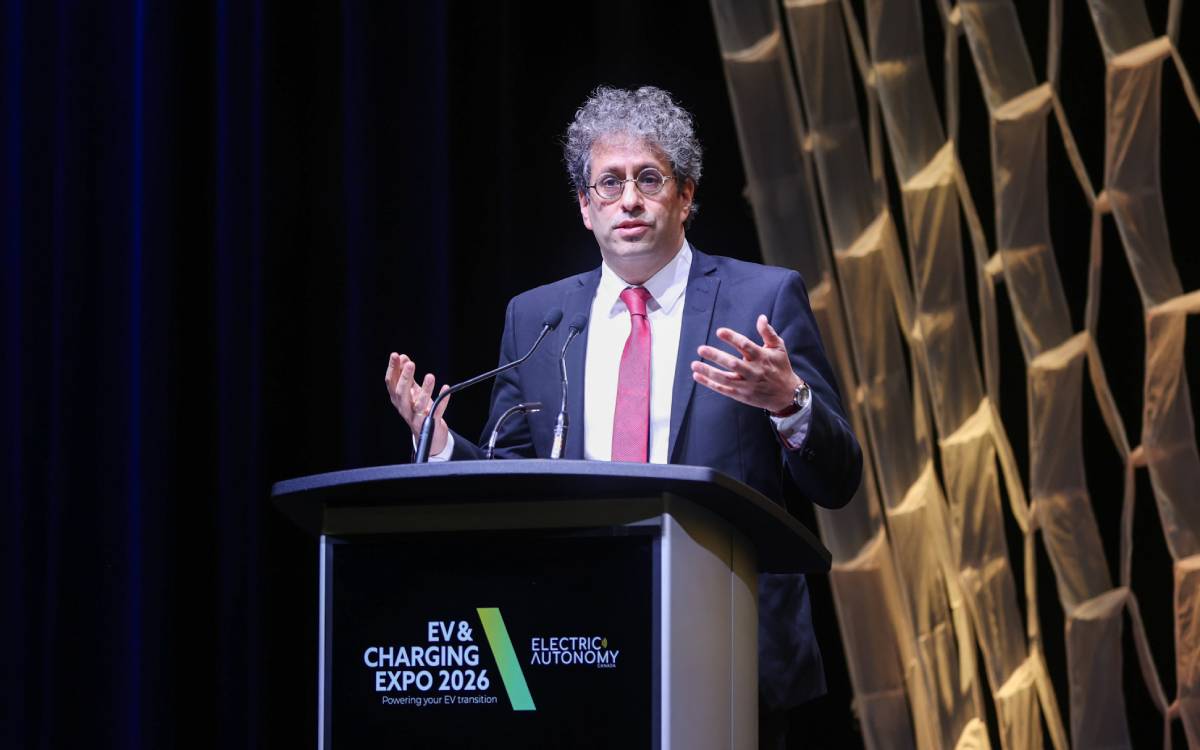
Parliamentary Secretary to the Minister of Industry, Karim Bardeesy, at the EV & Charging Expo 2026 on April 8. — Shane Parent, Electric Autonomy Canada
The Federal government announces 1,600 new chargers, more Plug’n Drive support in multi-million-dollar investment at the EV & Charging Expo 2026
The Canadian government will continue to support the rollout of public EV charging infrastructure with a $10.6 million investment in 14 projects for more than 1,600 chargers.
Karim Bardeesy, Parliamentary Secretary to the Minister of Industry, made the announcement at the EV & Charging Expo 2026 in Toronto on April 8.
Bardeesy announced the government will channel the investment through the Zero Emission Vehicle Infrastructure Program (ZEVIP).
Instill confidence
“These projects are going to instill that confidence — make sure that workers, that residents, that people who want electric vehicles have that sense that this is something that they can participate in,” says Bardeesy.
The largest portion of the new funding is going to the Greater Toronto Airport Authority. The company will receive $2,640,000 for 178 Level 2 chargers, 70 DC fast chargers at 20-49 kW and 14 DC fast chargers at 50-99 kW.
The smallest amount of funding goes to Saputo Dairy Products Canada GP at $99,999, which will support 20 Level 2 chargers in Alberta, Ontario, Quebec and Newfoundland and Labrador.
Selection process
Louise Tanguay is the deputy director of ZEVIP and says the 14 projects are already under construction in some form or another. Many other projects have been approved but are waiting for funding. She describes the selection process of successful funding candidates.
“We have a planning map, and it rates every segment of the national highway system from one to five. So, one is a segment that is well serviced, or it’s a segment that there’s no charging need, essentially, and a five is a high-needs area.
“Are there several EVs registered in that area? Population, traffic patterns, these are all things that we consider when we assess.”
See the full list of recipients here.
Plug’n Drive funding
The government, says Bardeesy, will also help with furthering public education.
Another $1.1 million will be earmarked for Plug’n Drive for its educational cross-country EV test drive tour.
“It’s important to build out the infrastructure, but we also have to build out the imagination,” says Bardeesy. “We have to expose electric vehicles to people and electric charging to people in places that don’t have the benefit of living in a large urban area.”
The Plug’n Drive tour focuses on small- and medium-sized communities where EV adoption is lower, helping drivers learn about EV technology, charging and ownership through credible information and hands-on experiences.
Going further for education
Tracy Walden, VP of engagement for Plug’n Drive, describes the experience and says the added funding will bring these tours further and to more “logistically difficult” places than ever before.
“We have what we call Mobile EV Education Trailers (MEETS), they are sea containers that travel on a tow truck. They’re all filled with EV education information on the inside and we have charger demos in there,” she says, adding that the MEETS are staffed by (often local) EV ambassadors.
“With this funding, we deploy MEETS as far as we can get. And then we do EV road shows out from there to reach communities that, without all those assets nearby, we wouldn’t be able to go, because it would be so logistically difficult to show up with EV ambassadors and vehicles.”